

TL;DR: SINOCO builds both industrial LED lighting (stadium floodlights, street lights, high bay) and equine red light therapy devices — a rare combination, since no other manufacturer we found does both. It works because the two product lines share the same core engineering: ripple-controlled LED drivers, precise thermal management, tight wavelength/CRI control, and a documented quality system (ISO 9001 for lighting, ISO 13485 for therapy devices). The wavelength, power scale, and certification path change; the underlying manufacturing discipline doesn’t. If you’re sourcing a custom LED manufacturer for any project, the real question isn’t “have they built this exact product before” — it’s “which of their existing capabilities already solves your hardest engineering problem.”
Custom LED Manufacturing: How One Factory Builds Both Stadium Floodlights and Horse Recovery Pads

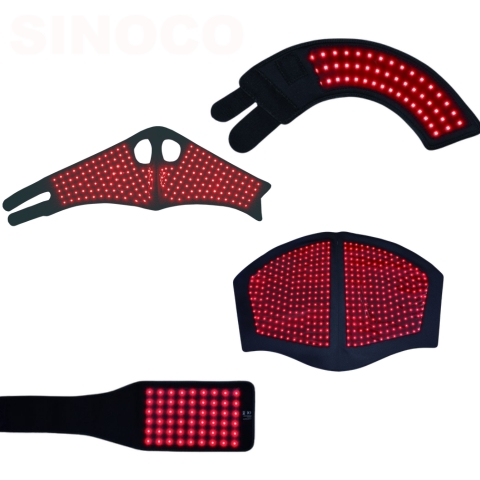
The first time a new client walks our production floor in Bao’an District, Shenzhen, I watch their face do the same thing almost every time. They came to source street lights or high bay fixtures. Halfway through the tour, they pass a bench where a technician is calibrating a red-and-near-infrared therapy pad for a horse’s cannon bone, and they stop walking.
“Wait — you make that too?”
Yes. We do. And I’ve come to realize that most buyers researching custom LED manufacturing have never actually had this question answered properly, because almost nobody in this industry does both. In fourteen years of sourcing guides, supplier comparisons, and technical breakdowns I’ve read online, I have never found one that explains why a factory capable of lighting a UEFA-standard football pitch is also qualified to build a medical-grade photobiomodulation device for a racehorse’s tendon. So we’re writing the guide we wish existed when we started doing this ourselves.
This isn’t a marketing page. It’s the engineering explanation — written by the team that actually runs the driver tests, machines the housings, and bins the LED chips — of what “custom LED manufacturing” really covers when a factory is built to serve more than one market at once, and what that should tell you if you’re evaluating a manufacturer for your own project.
The Short Answer, If You’re in a Hurry
Custom LED manufacturing that spans both industrial/municipal lighting and therapeutic or medical-adjacent LED devices is possible — and defensible — because both product categories are built on the same four engineering disciplines: constant-current driver design with controlled output ripple, thermal management of the LED junction, precise control of wavelength and optical output, and a documented quality system (ISO 9001 plus, where required, ISO 13485). A stadium floodlight and a red light therapy pad look nothing alike on the outside. Underneath, the physics a factory has to control is nearly identical. What changes is the target wavelength, the power scale, and the certification pathway — not the underlying manufacturing competence.
That’s the whole thesis. Everything below is us proving it, section by section, with the actual numbers we work to.
Why This Combination Is Rare — And Why It Isn’t a Gimmick
We founded SINOCO in Shenzhen in 2005 as a general LED lighting manufacturer: street lights, high bay lighting, flood lights, garden and landscape fixtures. Over twenty years we picked up national patents (more than twenty at last count), ISO 9001 and ISO 14001 certification, and export relationships across Europe, North America, and Asia. That’s the standard trajectory for a Chinese lighting OEM/ODM supplier, and there are hundreds of factories with a similar story.
What’s not standard is the equine and animal light therapy line. We added it because our own R&D team, while developing high-CRI, high-efficacy LED modules for horticultural and medical-adjacent lighting, kept running into the same photobiomodulation research that veterinary light therapy companies were citing — red light in the 660nm range and near-infrared around 850nm, used to support circulation and tissue recovery in horses. We already had the wavelength-binning capability, the driver engineering, and the ISO 13485 medical-device-adjacent quality process from other product lines. Building a therapy pad wasn’t starting from zero. It was redirecting a capability we already had toward a new application.
I want to be direct about something here, because I think it matters for trust: light therapy for horses is a supportive, non-invasive wellness tool, not a substitute for veterinary diagnosis or treatment. Any responsible manufacturer in this space — us included — should say plainly that these devices are not intended to diagnose, treat, or cure disease, and that a licensed veterinarian should be involved for any real injury or condition. We say that not as a legal formality but because it’s true, and because a factory that’s honest about the limits of its therapy products is one worth trusting on the specs it does claim.
The Four Engineering Disciplines Both Product Lines Share
1. Constant-Current Driver Design and Output Ripple Control
Every LED — whether it’s illuminating a football pitch for 4K slow-motion broadcast or delivering a 15-minute dose of red light to a horse’s suspensory ligament — is driven by a constant-current power supply, and the quality of that driver is the single biggest differentiator between a fixture that performs consistently and one that doesn’t.
For our stadium and high-mast flood lights, driver ripple matters because of broadcast cameras. When a slow-motion camera captures 300 frames per second, any low-frequency ripple in the driver’s output current (typically at 100 or 120 Hz, tied to AC line frequency) shows up as visible flicker across frames. Industry guidance from bodies like UEFA sets flicker factor targets under roughly 5% for elite-level stadium lighting under high-frame-rate capture. We test every new driver batch against this before it goes into production, using a flicker meter against the actual LED module, not just the driver spec sheet in isolation.
For our therapy pads, the same ripple-controlled driver architecture matters for a completely different reason: dosage consistency. Photobiomodulation research generally works in terms of energy density delivered to tissue, measured in joules per square centimeter (J/cm²), and irradiance, measured in milliwatts per square centimeter (mW/cm²) at the treatment surface. If the driver output isn’t stable, the actual irradiance delivered during a session drifts, and the dose the horse receives becomes inconsistent session to session. The same low-ripple driver discipline that keeps a stadium camera from catching flicker is what keeps a therapy pad delivering a repeatable, predictable dose.
2. Thermal Management of the LED Junction
LED lumen output and lifespan both degrade with heat. This is true whether the LED is a 300-watt high-power chip in a flood light or a lower-power chip in a flexible therapy pad array, and it’s the reason housing and heat-sink design is never a cosmetic decision in this industry.
On our industrial fixtures, we handle this with die-cast aluminum housings — usually ADC12 alloy for standard-wattage products, and A356-T6 for high-wattage or high-thermal-load applications where the extra cost is justified by better heat dissipation and corrosion resistance. Integrated fin arrays, sometimes as thin as 3mm, are cast directly into the housing to maximize surface area for passive cooling. A flat, CNC-machined mounting surface (we hold flatness tolerance around ±0.1mm) is what actually lets heat transfer efficiently from the LED board into that aluminum mass in the first place — a rough or uneven surface creates air gaps that insulate rather than conduct.
Therapy pads face the opposite constraint: they need to be flexible enough to wrap around a horse’s leg, so a rigid aluminum heat sink isn’t an option. Instead, thermal management here is about component-level current control and duty cycling — keeping each LED junction well within its safe thermal envelope through driver current limiting, because there’s no metal heat sink to fall back on. It’s a different solution to the same underlying problem: never let the junction temperature climb high enough to degrade output or shorten the device’s working life.
3. Wavelength, CCT, and Optical Output Control
This is where the two product lines look most different on paper but rely on the most similar underlying process: LED chip binning.
Street and flood lights need consistent correlated color temperature (CCT), usually somewhere in the 4000K–6500K daylight range for broadcast-quality color reproduction, along with a color rendering index (CRI) high enough — generally above 80, and above 90 for premium broadcast applications — to render colors accurately under television lighting consistency index (TLCI) standards. We source chips from established suppliers like Nichia, Cree, and partner with Mean Well on drivers specifically because binning consistency across a production run matters enormously; a batch of street lights with visibly inconsistent color temperature down a single road looks unprofessional and fails municipal specification review.
Therapy pads need something more specific: a tight wavelength band centered on roughly 660nm (visible red, associated in photobiomodulation literature with more superficial tissue effects) and roughly 850nm (near-infrared, associated with deeper tissue penetration), because the wavelength itself — not just the color the eye perceives — determines how the light interacts with tissue. This is a narrower, more demanding binning target than general-purpose lighting, and it’s exactly the kind of precision that a factory without a mature optical binning process struggles to hold consistently across a full production run. Having already built that discipline for our general lighting lines is what let us hit it reliably for a therapeutic product.
4. IP Rating, Mechanical Protection, and the Certification Pathway
Every product we make gets sealed and rated for its actual operating environment, but “environment” means something very different across the two product lines.
Our outdoor fixtures are built and tested to IP66 (complete protection against dust ingress and powerful water jets) and IK10 (impact resistance) ratings, because a street light or gas station canopy fixture has to survive years of rain, dust, vibration, and occasional vandalism without failing. We hold certifications relevant to each export market — UL and ETL for North America, TUV, ENEC, CB, CE, RoHS, and VDE for Europe, SAA and PSE for the Asia-Pacific region — and DLC listing specifically for North American utility rebate eligibility.
The therapy pad line runs through a different but equally rigorous track. Because these are wellness devices intended for repeated direct contact, we manufacture them under our ISO 13485 quality management certification — the standard specifically built for medical device manufacturing, covering design controls, risk management, and traceability well beyond what general ISO 9001 requires. It’s a heavier documentation burden, and honestly, it’s the reason we don’t recommend that every general lighting factory attempt to add a therapy product line casually. The certification pathway is genuinely different, even though the physics underneath overlaps.
Side-by-Side: What Actually Changes Between the Two Product Types
| Engineering Factor | Stadium / Industrial Fixture | Equine Therapy Pad |
|---|---|---|
| Driver output | Constant-current, ripple <5% at 100/120Hz for broadcast compatibility | Constant-current, ripple-controlled for dosage consistency |
| Thermal solution | Die-cast aluminum housing, integrated fin array, CNC-flattened mounting surface | Current-limited duty cycling, no rigid heat sink (flexible form factor) |
| Target wavelength/CCT | 4000K–6500K CCT, CRI 80+ (90+ for broadcast) | ~660nm red + ~850nm near-infrared |
| Ingress protection | IP66 / IK10 | Flexible neoprene housing, splash-resistant, not submersion-rated |
| Governing certification | ISO 9001, UL/ETL/DLC/CE/TUV depending on market | ISO 13485 quality system |
| Primary failure risk if built poorly | Flicker under broadcast cameras, premature LED lumen decay, water ingress | Inconsistent treatment dosage, uneven tissue exposure, premature battery/LED failure |
What This Should Tell You If You’re Sourcing a Custom LED Manufacturer
If you’re evaluating suppliers for a custom LED manufacturing project — whether it’s a lighting product, a wellness device, or something that doesn’t fit neatly into either category — here’s what we’d actually check, based on which side of this table your project sits closer to:
If your product needs consistent, camera- or eye-safe optical output over years of outdoor use: ask for the driver’s measured ripple percentage (not just the datasheet claim), the housing alloy and its flatness tolerance spec, and the actual IP/IK test reports, not just a marketing claim of the rating.
If your product involves direct, repeated contact with a living body — human or animal: ask specifically whether the factory holds ISO 13485, not just ISO 9001. This is the single clearest signal of whether a manufacturer has the design-control and risk-management discipline this category actually requires. A factory that only has general industrial certification can still build a good-looking prototype, but the ongoing quality consistency across thousands of units is a different promise entirely.
If your project is genuinely novel — something that doesn’t map cleanly to an existing catalog item: the most useful question isn’t “have you made this exact product before,” it’s “which of your existing product lines already solved the hardest engineering problem in mine?” That’s effectively the question those clients on our factory floor are asking when they stop walking past that therapy pad bench. The answer, for us, was: our stadium lighting line already solved driver ripple control, and our medical-adjacent certification work already solved the quality-system question. The therapy pad wasn’t a new competency. It was a recombination of two we already had.
Frequently Asked Questions
Can a factory that makes industrial lighting really be trusted to build a medical-adjacent or therapeutic LED product?
It depends entirely on whether they hold the relevant quality certification for that category — ISO 13485 for medical-device-adjacent manufacturing, not just general ISO 9001. The underlying LED and driver engineering does transfer between categories, but the certification, documentation, and risk-management process does not happen automatically just because a factory is good at making lighting fixtures.
What’s the difference between LED chip quality for industrial lighting versus therapeutic devices?
The core chip technology can be similar, but the binning tolerance is usually tighter for therapeutic applications, because the specific wavelength (not just the perceived color) determines the biological effect. General lighting tolerates a wider CCT/CRI range than a therapy device tolerates in its wavelength band.
Why does driver ripple matter for something that isn’t being filmed by a broadcast camera?
Because ripple isn’t only a visible-flicker problem — it’s a signal that the driver’s current output, and therefore the LED’s actual optical output, isn’t perfectly stable moment to moment. In broadcast lighting that shows up as visible flicker. In a therapy device it shows up as inconsistent dosage delivery, which matters even though no camera is watching.
Is IP66/IK10 rating relevant to a therapy pad?
Not directly — a therapy pad isn’t rated the same way because it isn’t a fixed outdoor fixture facing rain and impact. But the underlying engineering discipline of matching the sealing and housing design to the actual use environment is the same skill applied differently: outdoor fixtures get IP66/IK10 aluminum housings; wearable therapy devices get flexible, splash-resistant neoprene housings sized to the actual risk they face.
Should I be skeptical of a manufacturer that suddenly expands into a very different product category?
It’s a fair question to ask directly rather than assume either way. The useful test isn’t the category jump itself — it’s whether the new product is backed by the certification that category specifically requires, and whether the manufacturer can explain, in engineering terms, which existing capability the new product actually depends on. If they can’t explain that clearly, be more cautious.
Where This Leaves Us
We didn’t set out to become a case study in cross-category LED manufacturing. It happened because we kept the same engineering standards — driver quality, thermal discipline, optical precision, and documented quality systems — across every product line we built, and eventually those standards turned out to be portable to a market we hadn’t originally planned to enter. If there’s one thing worth taking from this, it’s that the question worth asking about any custom LED manufacturing partner isn’t “have you built exactly this before.” It’s “what have you already solved that this project actually needs” — because in our experience, that’s the question that actually predicts whether the finished product works.