

The evolution of equine sports medicine has reached a pivotal junction where professional trainers and veterinarians are moving away from superficial wellness gadgets and toward high-output clinical hardware. For those managing high-value performance horses, the difference between a minor strain and a career-ending injury often comes down to the efficiency of cellular repair. This is where high PPFD horse red light therapy pads have redefined the rehabilitation landscape, offering a level of photon density that was previously only available in static clinical laser systems. SinocoLED has pioneered this transition by miniaturizing industrial-strength LED technology into flexible, medical-grade neoprene wraps that deliver consistent, deep-tissue penetration.

High PPFD Horse Red Light Therapy Pads | SinocoLED Pro Recovery
Understanding the relationship between light intensity and biological response is essential for any equestrian professional looking to optimize recovery times. While many consumer-grade light wraps focus on the “red glow,” the biological magic happens at the mitochondrial level, which requires a specific threshold of energy to trigger photobiomodulation (PBM). SinocoLED Pro Recovery systems are engineered to exceed these thresholds, ensuring that the photons don’t just hit the hair and skin but reach the deep tendons, ligaments, and muscular structures where healing is most needed. By prioritizing high PPFD (Photosynthetic Photon Flux Density) in an equine context, we are essentially providing the cellular “fuel” required for accelerated ATP production and rapid inflammatory reduction.
The Science of High Intensity Equine Photobiomodulation and ATP Production
At the core of every SinocoLED Pro Recovery session is a complex biochemical reaction known as the Emerson Effect’s animal-tissue equivalent. When specific wavelengths of red (660nm) and near-infrared (850nm) light are delivered with high intensity, they are absorbed by cytochrome c oxidase within the mitochondria. This absorption displaces nitric oxide, allowing oxygen to bind more effectively and drastically increasing the production of adenosine triphosphate (ATP). For a horse recovering from a bowed tendon or a suspensory ligament injury, this surge in cellular energy is the difference between a 60-day and a 30-day recovery window.
The “Performance Gap” in the equine market today is largely due to the use of low-output LEDs that lack the “punch” to penetrate the thick dermal layers and dense hair coats of most horse breeds. High PPFD ratings, typically exceeding 120 mW/cm² at the surface, ensure that even after the light travels through the skin, the energy levels remain high enough to stimulate deep-seated fibroblasts. These specialized cells are responsible for collagen synthesis, which is the foundational building block for repairing damaged connective tissues. SinocoLED’s commitment to industrial-grade diode density ensures that our therapy pads provide a uniform energy map, eliminating the “dead zones” common in cheaper, battery-drained alternatives.
Penetrating the Dermal Barrier with Near-Infrared Synergy
While red light at 660nm is spectacular for wound healing and skin-level issues like rain rot or summer sores, it lacks the depth required for musculoskeletal repair. This is why the SinocoLED ST-HTL series utilizes a dual-chip architecture that pairs 660nm diodes with high-powered 850nm near-infrared (NIR) emitters. The NIR spectrum exists in the “optical window” of animal tissue, meaning it can travel up to 10-15cm into the body without being absorbed by water or hemoglobin. This allows the therapy to reach deep into the hock joints, the sacroiliac (SI) region, and the dense muscles of the hindquarters.
The synergy between these two wavelengths, when backed by high PPFD, creates a systemic anti-inflammatory effect. As the light energy improves microcirculation, it facilitates the drainage of lymphatic fluid and the removal of lactic acid buildup after intense competition. Trainers using SinocoLED Pro Recovery pads often report that their horses show a visible reduction in “filling” or “windpuffs” after just one 15-minute session. This is not just a temporary masking of symptoms; it is a fundamental shift in the horse’s metabolic recovery rate, allowing for more consistent training schedules and improved athletic longevity.

Comparative Advantage: SinocoLED vs. Consumer-Grade Wraps
| Feature | SinocoLED Pro Recovery (Industrial) | Standard Equestrian Wraps | Amazon Budget Diodes |
| PPFD / Irradiance | 120+ mW/cm² (Deep Penetration) | 20–40 mW/cm² (Surface Only) | <10 mW/cm² (Decorative) |
| Wavelength Precision | 660nm + 850nm + 730nm (Dual/Triple) | 660nm + 850nm (Standard) | Uncalibrated Red/Blue |
| Battery Stability | High-Discharge Lithium (Constant Power) | Low-Grade Internal (Fades Fast) | Plug-in Only / Short Lead |
| Diode Quality | Medical-Grade Samsung/Osram | Generic White-Label | Plastic-Encapsulated |
| Durability | IP54 Waterproof Neoprene | Standard Fabric | Cheap PVC |
When we analyze the competitive landscape, it becomes clear that most “lifestyle” equine therapy brands prioritize ease of use over clinical efficacy. While a lightweight, low-power wrap might be easier to throw in a grooming kit, it often fails to deliver the “therapeutic dose” required to make a clinical difference. SinocoLED bridges this gap by offering a foldable, portable design that maintains the power output of a stationary solarium. By using high-discharge lithium-ion batteries, our pads maintain a consistent PPFD throughout the entire 15-minute cycle, whereas many competitors see a 30% drop in light intensity as the battery weakens.
Furthermore, the physical construction of horse infrared recovery equipment must be able to withstand the harsh environment of a professional stable. Ammonia from bedding, moisture from sweat, and the occasional hoof strike can destroy sensitive electronics. SinocoLED utilizes a patented sealing process that gives our pads an IP54 rating, protecting the diodes from dust and water splashes. This industrial durability ensures that your investment continues to provide professional-grade therapy for years, rather than months, making it the most cost-effective solution for large-scale training facilities and rehabilitation centers.
Targeted Recovery Protocols for High-Value Performance Horses
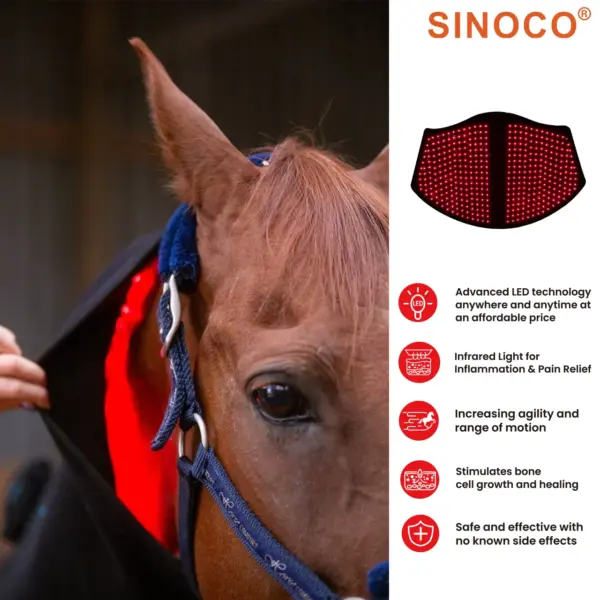
Effective use of high PPFD horse red light therapy pads requires more than just strapping them on; it requires a strategic approach to different injury types. For acute injuries like a fresh kick or a recent strain, the primary goal is the reduction of edema and pain. In these cases, the “Pulse Mode” on SinocoLED devices is particularly effective. Pulsed light therapy has been shown to enhance the analgesic effect by preventing the “accommodation” of nerve endings, effectively “tricking” the body into a continuous state of repair and pain relief.
For chronic conditions such as equine osteoarthritis or “kissing spine,” a daily maintenance protocol is recommended. By applying the Apollo Equine Pad to the affected vertebrae or joints for 20 minutes before tacking up, you are essentially “pre-heating” the mitochondria and increasing the elasticity of the connective tissues. This results in a horse that is more “supple” from the start of the ride, reducing the risk of compensatory injuries. The high PPFD ensures that even in the dense spinal region, the light energy is reaching the deep-seated multifidus muscles that support the vertebral column.
Managing Tendon and Ligament Health in Racehorses and Jumpers
Tendon injuries are the “nightmare” of the equestrian world due to their slow healing and high rate of reinjury. The “scar tissue” that typically forms during tendon repair is much less elastic than the original fiber, leading to “bowed” tendons. However, SinocoLED Pro Recovery therapy stimulates organized collagen fiber alignment. By increasing the presence of Type I collagen over Type III, high-intensity red light therapy helps the tendon regain its original strength and elasticity, rather than just filling the gap with brittle scar tissue.
Using a high-PPFD leg wrap specifically on the cannon bone and fetlock areas after every jump school or gallop can act as a preventative measure. This proactive approach to “Micro-trauma” allows the body to repair small tears before they become clinical lameness. In the high-stakes world of Thoroughbred racing and Grand Prix jumping, these marginal gains in tissue integrity are what separate the winners from those sitting on the sidelines.
Frequently Asked Questions: Mastering Equine Red Light Therapy
1. What is the difference between PPFD and Wattage in horse therapy pads?
Wattage only tells you how much electricity the device consumes, not how much light is actually reaching the horse. PPFD (Photosynthetic Photon Flux Density) or Irradiance ($mW/cm^2$) is the only metric that matters for healing. SinocoLED focuses on high-irradiance output, ensuring that the light energy is strong enough to penetrate the hair coat and skin to reach deep muscles and tendons.
2. Can I use red light therapy on a wet horse?
While the therapy is non-invasive, we recommend that the horse’s skin is clean and dry for maximum photon absorption. Water on the coat can refract the light, reducing the effective PPFD. Additionally, while SinocoLED pads are water-resistant (IP54), keeping the charging ports away from excessive moisture is a best practice for longevity.
3. How long does it take to see results with SinocoLED Pro Recovery?
For acute swelling and pain, users often see a visible reduction in inflammation after a single 15-minute session. For structural issues like tendon repair or arthritis, measurable progress (via ultrasound or improved mobility) is typically observed after 3-4 weeks of consistent, daily application.
4. Is “Pulse Mode” better than “Continuous Mode” for horses?
Both have their place. Continuous mode is excellent for deep tissue penetration and maximum energy delivery (ATP production). Pulse mode is often preferred for neurological pain and acute inflammation, as the flickering light can stimulate the lymphatic system more aggressively and provide faster analgesic (pain-killing) effects.
5. Can you “overdose” a horse with red light therapy?
Because SinocoLED uses non-thermal LEDs rather than high-power lasers, there is no risk of burning the tissue. However, cells can reach a “saturation point” where they can no longer absorb photons. We recommend 15-20 minute sessions per area. Doing more will not hurt the horse, but it won’t provide additional benefits once the mitochondria are “fully charged.”
Final Thoughts: The Future of Equine Longevity starts with SinocoLED
Investing in high PPFD horse red light therapy pads is more than a purchase; it is a commitment to the long-term biological health of your equine partners. As we move into an era where pharmaceutical interventions are highly scrutinized and “drug-free” recovery is the goal, SinocoLED Pro Recovery stands as the gold standard for non-invasive care. By leveraging industrial-grade power and scientific precision, we ensure that every session contributes to a stronger, faster, and more resilient horse.
Ready to upgrade your stable’s recovery protocol? Explore the full range of SinocoLED Equine Solutions and give your horse the professional-grade support they deserve.