

Quick Summary (TL;DR)
- What this covers: Everything to evaluate when sourcing from industrial led lighting manufacturers — every major industrial LED product category, the specs that actually matter for each, and how to match product type to application.
- The core buying mistake: Treating “industrial LED lighting” as one product category. A warehouse ceiling, a hazardous gas station canopy, and an outdoor facade each need a fundamentally different fixture, and evaluating them against the same checklist leads to the wrong purchase.
- The spec that matters more than wattage across every category: Efficacy (lm/W) combined with thermal management — two fixtures with identical wattage can deliver meaningfully different real-world output and lifespan depending on driver quality and heat dissipation design.
- What we can confirm about our own range: As a manufacturer operating vertically integrated production (our own foundry and assembly, not outsourced), our industrial range spans high bay, flood, gas station, explosion-proof canopy, and outdoor facade lighting, holding ISO9001/ISO13485/ISO14001/ISO45001 and product certification to TUV, CE, RoHS, UL, ETL, and DLC standards, with a documented qualified-product rate above 99.99%.
As a manufacturer producing across the full industrial LED category rather than specializing in a single fixture type, we get asked constantly to explain the actual differences between product lines that get lumped together under “industrial lighting” in casual conversation. The honest answer is that each category solves a genuinely different engineering problem, and sourcing the wrong type for your application — even from a reputable manufacturer — produces a poor result regardless of build quality. This guide walks through every major industrial LED category, what distinguishes a well-engineered fixture in each, and how to match the right product to your actual facility.
Industrial LED Lighting Manufacturers: Complete Guide
In this guide, you’ll get every major industrial LED lighting category explained — what each is actually engineered to solve, the specs that matter for each, and how to evaluate a manufacturer’s full range rather than just one product line.
Why “Industrial LED Lighting” Isn’t One Category
This gets collapsed constantly in sourcing conversations. A fixture engineered for a 12-meter warehouse ceiling, one engineered for a hazardous fuel-vapor environment, and one engineered for outdoor flood coverage share a power source and an LED chip technology — and almost nothing else in terms of the actual engineering requirements. Evaluating a manufacturer properly means understanding what each category is actually solving, not assuming competence in one implies competence across all of them.
Category 1: LED High Bay Lighting

What it’s engineered to solve: Illuminating large, tall-ceiling interior spaces — warehouses, manufacturing floors, distribution centers — where fixtures are typically mounted 6 to 15+ meters above the working floor.
What actually matters in this category:
- Beam angle and distribution — a narrow beam concentrates light directly below the fixture (suited to aisle lighting or high mounting), while a wider beam spreads coverage for open floor areas; the wrong distribution for your mounting height and layout creates uneven lighting regardless of total output.
- Color Rendering Index (CRI) — matters more than it’s often given credit for in industrial settings, since poor color rendering increases eye strain and can obscure visual inspection tasks on a production line. A CRI of 80+ is a reasonable minimum for most industrial applications; detailed inspection work benefits from higher.
- Zero-flicker driver design — flicker, even imperceptible to the naked eye, contributes to worker eye strain and fatigue over a full shift, and is a differentiator between a well-engineered driver and a budget one.
- Thermal management — high bay fixtures run at significant wattage in often poorly ventilated ceiling spaces; inadequate heat dissipation accelerates LED and driver degradation.
Category 2: LED Flood Lighting

What it’s engineered to solve: Wide-area outdoor illumination — building perimeters, storage yards, loading docks, facades, and sports or recreational facilities.
What actually matters in this category:
- IP rating — full outdoor exposure demands IP65 or higher as a baseline, with attention to gasket and seal quality specifically, since this is the most common point of premature failure in flood fixtures.
- Glare control and beam angle options — flood lighting aimed poorly creates both wasted light spill and genuine glare hazard for anyone nearby; a manufacturer offering multiple beam angle options (narrow, medium, wide) for the same fixture family gives more control over actual site layout.
- Surge protection — outdoor installations are more exposed to grid transients and lightning-induced surges than indoor fixtures, making surge protective devices a meaningful reliability factor, not an optional add-on.
- Thermal fin design — flood fixtures often run high wattage in a compact housing; die-cast aluminum housings with substantial fin surface area (such as ADC12 aluminum construction) manage heat more effectively than minimal, undersized heat sinks.
Category 3: Explosion-Proof and Hazardous Location Industrial Lighting
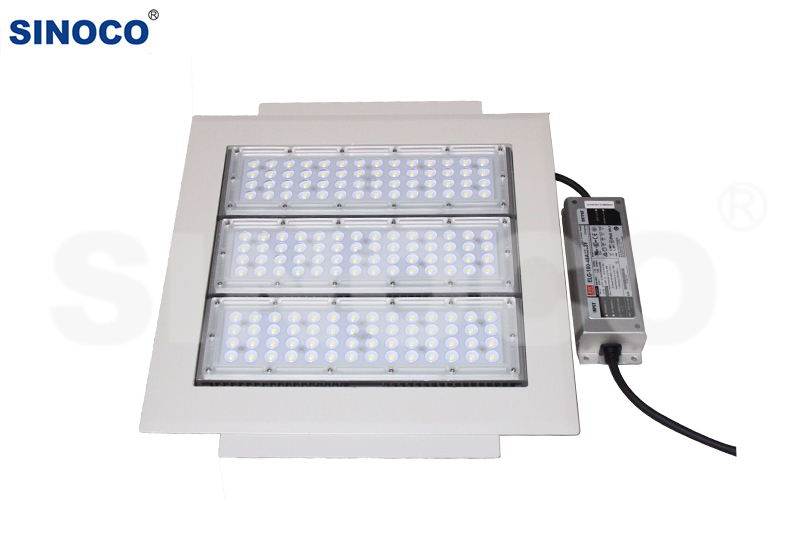
What it’s engineered to solve: Safe illumination in environments where flammable gases, vapors, or combustible dust are present — gas stations, chemical plants, grain facilities, and similar high-risk environments.
What actually matters in this category: This is a fundamentally different compliance category from general industrial lighting, governed by hazardous area zone classification (ATEX/IECEx Zones or NEC Class/Division systems), with requirements including:
- Zone/Division-appropriate certification, confirmed against your facility’s own hazard assessment, not assumed from a generic “explosion-proof” label
- Temperature (T) rating, which must stay below the auto-ignition temperature of the specific substances present at your facility
- Verified certificate numbers from the relevant certifying body (ATEX notified body, IECEx, or UL for North America), checked against the issuing body’s public database rather than accepted on a datasheet claim alone
A high IP rating is not a substitute for explosion-proof certification — they test entirely different things, and a buyer sourcing for a hazardous environment needs the specific certification for that classification, not general industrial-grade lighting.
Category 4: LED Gas Station and Canopy Lighting

What it’s engineered to solve: Illuminating fuel dispensing canopies and forecourts — a specific application combining hazardous-area considerations (proximity to fuel vapors) with the need for even, glare-controlled coverage over a defined canopy area.
What actually matters in this category:
- Recessed, flush-mount housing design — canopy fixtures typically need a low-profile design that doesn’t create a snag or impact point for vehicles and equipment beneath the canopy.
- High uniformity across the canopy surface — uneven lighting on a forecourt creates both a safety concern (dark pooling areas) and a poor customer experience; uniformity ratio matters as much here as in any roadway lighting application.
- Appropriate hazardous-area rating for the fixture’s proximity to the actual fueling points, confirmed against your site’s specific hazard assessment.
Category 5: Intelligent and Smart-Control Industrial Lighting

What it’s engineered to solve: Reducing energy consumption and extending maintenance intervals in facilities with variable occupancy or usage patterns, through smart dimming, scheduling, and remote monitoring.
What actually matters in this category:
- Protocol compatibility — LoRaWAN, Zigbee, and NB-IoT are common smart-control protocols; confirming which your facility’s control system (or planned control system) actually supports avoids a costly mismatch after installation.
- Dimming floor compliance — any adaptive dimming schedule still has to respect minimum illuminance requirements for the space’s safety classification; a smart system that dims below that floor isn’t actually compliant regardless of the energy savings it generates.
- Centralized monitoring capability — for large facilities, the ability to monitor fixture status and energy use remotely meaningfully reduces maintenance response time compared to manual spot-checks.
Category 6: LED Roadway and Outdoor Area Lighting for Industrial Sites

What it’s engineered to solve: Perimeter roads, parking areas, and loading zones around industrial facilities — overlapping with municipal street lighting engineering but scaled to a private site’s specific traffic and security needs.
What actually matters in this category: The same core principles covered in highway and street lighting engineering apply here — mounting height driving spacing ratio, uniformity targets, and glare control — but typically at a smaller scale and with more flexibility in pole placement than public roadway projects, since private site layouts aren’t bound by the same public right-of-way constraints.
What Ties These Categories Together: Evaluating a Manufacturer’s Full Range
A manufacturer genuinely capable across multiple industrial categories — rather than specializing narrowly and relabeling the same base fixture for different applications — should be able to speak specifically to the different engineering requirements of each.
As a manufacturer producing across this full range ourselves, here’s what we can confirm about how our own operation approaches it: we run vertically integrated production (our own foundry and assembly workshop, not outsourced), hold ISO9001, ISO13485, ISO14001, and ISO45001 certification, and our products carry certification to TUV, CB, ENEC, CE, RoHS, SAA, PSE, UL, ETL, and DLC standards depending on category and destination market, with a documented qualified-product rate above 99.99%. We also work with named component partners — NICHIA and CREE for LED chips, MEAN WELL for drivers — across these product lines rather than unbranded generic components.
What this means for evaluating any manufacturer’s range, not just ours: Ask whether their explosion-proof line actually carries distinct, verifiable hazardous-area certification (not a relabeled general-purpose fixture), whether their high bay and flood lines use genuinely different thermal and optical engineering (not the same housing with a different mounting bracket), and whether certification claims are backed by checkable certificate numbers specific to each product category.
Common Mistakes Buyers Make When Sourcing Across Industrial Categories
- Assuming one fixture type can be adapted across applications. A high bay fixture repurposed as flood lighting, or vice versa, is rarely optimized for either job.
- Treating a manufacturer’s general certification claims as covering every product line. Certifications — especially hazardous-area ratings — are model-specific.
- Prioritizing wattage over beam distribution and thermal design. Two fixtures with identical wattage can perform very differently based on optics and heat management.
- Overlooking CRI and flicker in high bay applications. These affect worker comfort and safety over a full shift, not just visual appearance.
- Sourcing explosion-proof lighting without confirming facility-specific zone classification first. This has to come from your own hazard assessment, not a product catalog.
Frequently Asked Questions
What’s the difference between LED high bay and LED flood lighting?
High bay lighting is engineered for tall-ceiling interior spaces with specific beam distribution and CRI considerations for worker comfort. Flood lighting is engineered for wide-area outdoor coverage with IP rating, glare control, and surge protection as primary concerns. They solve different problems even though both can be high-wattage fixtures.
Can I use a standard industrial fixture in a hazardous location?
No — hazardous locations require specific explosion-proof or intrinsically safe certification tied to your facility’s zone/division classification. A standard high IP-rated fixture is not a substitute, since IP rating and hazardous-area certification test entirely different things.
Do I need different manufacturers for different industrial lighting categories, or can one supplier cover everything?
A manufacturer with genuine engineering depth across categories — not just relabeled fixtures — can supply multiple categories reliably. The key verification is confirming each category’s claims (certifications, thermal design, optics) are specific to that product line rather than generic across their catalog.
What certifications should I expect from a reputable industrial LED lighting manufacturer?
At minimum, ISO9001 for quality management, plus product-level certifications relevant to your market and application — CE and RoHS for the EU, UL and ETL for North America, DLC for utility rebate eligibility, and hazardous-area specific certification (ATEX/IECEx or NEC-based) if your application requires it.
How do smart-control features fit into industrial LED lighting sourcing?
Confirm protocol compatibility (LoRaWAN, Zigbee, NB-IoT) with your facility’s existing or planned control system before ordering, and verify any dimming schedule still meets minimum illuminance requirements for your space’s safety classification.
Final Thoughts: Choosing Industrial LED Lighting Manufacturers Across Your Full Facility
Evaluating industrial led lighting manufacturers properly means recognizing that your facility likely needs several distinct product categories, not one fixture type applied everywhere. High bay, flood, explosion-proof, gas station canopy, smart-control, and outdoor area lighting each solve different engineering problems, and a manufacturer worth working with across your full facility should be able to speak specifically to each — backed by verifiable certifications, named component sourcing, and documented quality metrics rather than general claims.
Match the product category to the actual application first, then evaluate the manufacturer’s depth within each category you need — that order prevents the most common sourcing mistake in this space: picking a manufacturer first and then forcing every application into whatever product line they happen to push hardest.