

Every year I speak with municipal engineers, electrical contractors, wholesale distributors, and facility managers from over 40 countries. And every single year, the conversation starts the same way: someone bought the wrong LED street light, installed it across an entire project, and is now dealing with the consequences — underlit roads, failed compliance audits, premature fixture failures, or a supplier who disappeared after the payment cleared.

LED Street Light Buying Guide: Everything You Need to Know Before You Buy
This guide exists to make sure that never happens to you.
I have spent over 20 years manufacturing LED street lights at Sinocoled. I have seen every specification mistake, every certification misrepresentation, and every procurement shortcut that eventually costs more than it saved. What you are about to read is the guide I wish every buyer had before they placed their first order — a complete, honest, technically accurate reference that covers every decision point from initial specification through to long-term maintenance planning.
By the time you finish reading, you will understand luminous efficacy and why wattage alone means nothing, what every certification actually tests and why some matter far more than others, how to read a photometric datasheet without an engineering degree, what smart controls are worth investing in and what is marketing noise, and how to evaluate a manufacturer versus a trading company when both claim to be “the factory.”
No need to search anywhere else. Everything you need to make a confident, correct purchasing decision is right here.
Chapter 1: Why LED Street Light Procurement Goes Wrong — and How This Guide Fixes It
The LED street light market is one of the most technically complex and specification-sensitive categories in all of B2B lighting. It is also one of the most polluted with misrepresentation.
A buyer searching for “LED street light supplier” in 2026 encounters thousands of results — manufacturers, trading companies, aggregators, and resellers who all present themselves identically. Product photographs look similar. Certification logos look similar. Claimed specifications look similar. And then the products arrive on site, and the differences become visible very quickly: inconsistent lumen output, premature driver failure, IP ratings that fail in the first rainy season, and certifications that turn out to be photocopied from another manufacturer’s documentation.
I am not describing a rare edge case. I have spoken with procurement teams from municipal authorities in three continents who have experienced exactly this scenario. The root cause is always the same: the buyer did not know what specific questions to ask and what specific documents to verify before placing the order.
This guide teaches you exactly that.
Chapter 2: The Five Numbers Every LED Street Light Specification Must Include
Before we cover any individual product category, material, or certification, I want to establish the five numbers that must appear in every LED street light specification — for any project, any road type, any budget. Without all five, the specification is incomplete and open to substitution with inferior products.
Number 1: Luminous Efficacy (lm/W)
Efficacy is the single most important performance metric in an LED street light specification. It measures how efficiently the fixture converts electrical power into visible light — expressed as lumens per watt (lm/W). A higher efficacy means more light for the same energy consumption.
In 2026, the minimum acceptable efficacy for a professional-grade LED street light is 130 lm/W for standard applications and 150 lm/W for efficiency-focused or DLC Premium-qualifying projects. Our Sinocoled Series VEGA range delivers 150–180 lm/W across all wattage configurations — among the highest efficacy ratings for road-rated luminaires currently available from any manufacturer at factory-direct pricing.
The practical consequence of efficacy on project cost is enormous. A 100W luminaire at 100 lm/W delivers 10,000 lumens. A 100W luminaire at 160 lm/W delivers 16,000 lumens — 60% more light at zero additional energy cost. This means a project specified at 100 lm/W requires significantly higher wattage (and therefore higher energy bills for 20 years) to achieve the same road illuminance as a 160 lm/W product.
Always request the LM-79 tested efficacy figure — not the datasheet claimed figure, not the LED chip efficacy (which is always higher than the system efficacy), but the complete luminaire efficacy measured at the output of the full assembled fixture by an accredited third-party laboratory.
Number 2: Total Lumen Output (lm)
Total lumen output is the actual measured light delivered by the complete luminaire system. This figure must come from an IES LM-79 test report from an accredited laboratory — not a calculated estimate, not the LED module’s rated lumens, and not a manufacturer’s specification sheet without supporting test documentation.
At Sinocoled, we publish LM-79 test reports for every product in our Series VEGA range and make them available to buyers before purchase. Any manufacturer who cannot provide LM-79 documentation on request should be removed from your shortlist immediately.
Number 3: Lumen Maintenance (L70/L80 Rating)
The L70 rating is the number of hours at which the luminaire will have depreciated to 70% of its initial lumen output — verified through IES LM-80 testing of the LED module at multiple temperature points, with IES TM-21 extrapolation used to project the full lifetime beyond the test period.
For 2026 projects, the minimum acceptable L70 rating is 50,000 hours — approximately 11–14 years of nightly operation at 10–12 hours per night. Premium products achieve L80 ≥ 60,000 hours or L70 ≥ 100,000 hours. Our Series VEGA standard range is rated L70 ≥ 50,000 hours, with our premium configurations achieving L80 ≥ 60,000 hours.
Any specification that lists wattage and total lumens without also specifying L70 lumen maintenance is incomplete. A luminaire that delivers 16,000 lumens on day one but drops to 8,000 lumens by year three has failed its specification — even if it is still technically “working.”
Number 4: IP and IK Rating
The IP (Ingress Protection) rating defines protection against dust and water. For outdoor road lighting, the minimum acceptable rating is IP65 — fully dust-proof and protected against low-pressure water jets from any direction. For exposed highway applications, coastal environments, or locations with heavy rainfall, IP66 (protection against powerful water jets) is the correct specification.
The IK (Impact Protection) rating defines mechanical resistance to physical impact. IK08 is the minimum for suburban road lighting. IK10 — the highest classification, rated for 20 joule impacts — is specified for highway, arterial, and any location where vehicle collision risk, maintenance equipment impact, or vandalism is a realistic possibility.
At Sinocoled, our Series VEGA 100W and above carry IP66 / IK10 as standard. Our residential and pedestrian range carries IP65 / IK08 minimum.
Number 5: Correlated Colour Temperature (CCT) and Colour Rendering Index (CRI)
CCT determines the colour appearance of the light — measured in Kelvin. The 2026 standard recommendation for general road lighting is 4000K (neutral white), which provides excellent visibility and colour rendering at moderate blue light content. For residential streets and dark-sky sensitive areas, 3000K (warm white) is increasingly specified and in some jurisdictions required by dark-sky ordinances. For high-security and industrial perimeter applications, 5000K is sometimes appropriate.
CRI measures how accurately the light renders colours compared to natural daylight — scored from 0 to 100. Road lighting minimum is CRI 70. CRI 80 is specified for conflict zones, pedestrian-priority areas, and any application where colour recognition matters (CCTV camera performance, vehicle colour identification, pedestrian safety).
All Sinocoled Series VEGA products are available in 3000K, 4000K, and 5000K CCT with CRI 70+ as standard and CRI 80+ available on request.
Chapter 3: Certification Guide — What Every Mark Actually Tests
This is the section of the buyer’s guide that protects your project and your procurement reputation. Certification misrepresentation is widespread in the LED street light supply chain. Understanding what each certification actually tests — and what verification looks like — is essential knowledge for every buyer in 2026.
CE Marking (Europe)
CE marking is a mandatory legal requirement for any LED street light product sold or imported into European Union markets. It is not a quality certification — it is a legal declaration that the product complies with the specific EU directives that apply to it. For LED street lights, these include the Low Voltage Directive (LVD) covering electrical safety for equipment operating between 50–1000V AC, and the Electromagnetic Compatibility (EMC) Directive.
CE marking alone does not guarantee product quality. It guarantees minimum legal compliance. The key documents to request are the Declaration of Conformity (DoC) and the test reports from the specific Notified Body (for high-power street lights, self-declaration is often insufficient). A CE logo on a product without a verifiable DoC referencing a specific Notified Body is a red flag.
Sinocoled holds full CE certification for our complete LED street light range with test reports from accredited European Notified Bodies, available on request for all procurement processes.
ENEC (European Norms Electrical Certification)
ENEC is a voluntary European certification for luminaires that goes significantly beyond the basic CE requirement. It involves independent testing and ongoing factory surveillance audits by ENEC-accredited certification bodies — making it a genuine quality signal rather than a self-declaration.
ENEC certification is increasingly required by European municipal procurement specifications and is effectively a prerequisite for supplying to many European government lighting tenders. Sinocoled holds ENEC certification on our core road lighting models — one of relatively few Chinese LED street light manufacturers to do so.
DLC SSL V6.0 (North America)
The DesignLights Consortium released the final version of SSL V6.0 in November 2025, representing the first major update to North America’s lighting product performance requirements in five years. Applications opened on January 5, 2026, and all non-compliant illumination products will be delisted from the DLC Qualified Products List by October 1, 2026.
Key changes in V6.0 directly impact roadway lighting specifications. Higher efficacy thresholds mean minimum efficacy requirements increase by an average of 14% across most product types, with category-specific increases up to 19%. Premium-tier products must achieve 20 lm/W higher efficacy than standard listings. Mandatory dimming functions require standard-tier outdoor lights to support continuous dimming down to at least 20%, while premium-tier products require dimming to 10% or lower.
For North American buyers, DLC listing is necessary for utility rebate eligibility in the USA and Canada. All Sinocoled Series VEGA products at 150–180 lm/W remain fully above the new V6.0 minimum thresholds. We hold current DLC test data and can provide V6.0 compliance documentation on request.
California Title 24 / JA8-2025
As of January 1, 2026, the California Energy Commission’s 2025 Title 24 Building Energy Efficiency Standards have taken full effect. All lighting products used in new construction, additions, and alterations in California must now bear the JA8-2025 or JA8-2025-E label and be registered in the CEC database — previous JA8-2022 labels are now invalid.
For any project in California, confirm JA8-2025 compliance specifically — not the previous 2022 label.
LM-79 and LM-80
These are IES (Illuminating Engineering Society) testing standards rather than certifications, but they are as important as any certification mark when evaluating product quality.
LM-79 measures the complete luminaire’s photometric performance — total lumen output, luminous efficacy, power factor, THD, and colour characteristics — at the system level, not the chip level. LM-80 measures LED module lumen maintenance at multiple temperature points over a minimum of 6,000 test hours. TM-21 extrapolates LM-80 data to project the actual L70 lifetime beyond the test period.
Always request both. Any supplier who provides LM-79 data only for the LED chip and not the complete luminaire system is presenting a misleading efficacy figure — chip efficacy is always higher than system efficacy due to driver losses, optical losses, and thermal losses in the complete assembly.
ISO 9001, ISO 14001, ISO 45001
These manufacturing-level management system certifications confirm that the supplier operates formal, audited quality management (ISO 9001), environmental management (ISO 14001), and occupational health and safety management (ISO 45001) systems. They do not test the product directly, but they signal the operational seriousness of the manufacturer — suppliers who hold all three are subject to regular third-party audits of their entire manufacturing process.
Sinocoled holds ISO 9001, ISO 14001, and ISO 45001 certification across our Shenzhen manufacturing facility. Our factory covers 10,000 square metres with over 200 production staff and an in-house R&D team holding 30+ national patents.
Surge Protection: ANSI C136.2-2023
Highway fixtures are exposed to lightning strikes, grid transients, and harsh weather. In 2026, premium roadway luminaires come equipped with surge protection in the range of 10kV/10kA to 20kV/10kA, meeting standards such as ANSI C136.2-2023 Extreme.
For highway and exposed rural road applications, always specify surge protection to ANSI C136.2-2023 Extreme (20kV/10kA). For urban arterial and residential roads, 10kV/10kA is the minimum acceptable. Sinocoled Series VEGA 100W and above include 10kV surge protection as standard, with 20kV available on specified models.
Chapter 4: Understanding LED Street Light Types — Which Category Fits Your Project

Not all LED street lights are the same product category. Choosing the correct type for your application determines whether the installation meets its performance requirements — or fails them.
Standard LED Street Lights (30W–300W)
The core product category — a pole-mounted luminaire with integrated LED module, driver, and optic, designed for road surface illumination. Available in a complete wattage range from 30W (residential pedestrian paths) through 300W (high-mast and interchange applications).
This is the category where most procurement decisions are made and where the widest range of product quality exists — from genuine certified products to misrepresented commodity imports. Our Series VEGA range covers 30W–300W in this category with full IES LM-79 data, CE, ENEC, CB certification, and LM-80 lumen maintenance documentation.
Intelligent / Smart LED Street Lights

Smart LED street lights integrate a communication module — LoRaWAN, ZigBee, NB-IoT, or a proprietary protocol — that enables individual luminaire control and monitoring from a central management system (CMS). Individual dimming schedules, real-time fault detection, energy metering at luminaire level (DALI2 D4i), and remote parameter adjustment are all enabled through smart control.
Adaptive lighting systems that adjust output based on real-time traffic, weather conditions, and pedestrian presence offer substantial benefits. DOE data shows that adding adaptive dimming and motion response to a standard LED installation can reduce energy consumption by a further 30–50%.
When specifying smart LED street lights, confirm compatibility with your existing or planned CMS platform. The two hardware standards that ensure interoperability are the NEMA socket (3, 5, or 7 pin) for plug-and-play smart node attachment, and the ZHAGA Book 18 socket for next-generation smart control integration. Sinocoled intelligent street lights support both socket standards as standard in our 2026 range.
Solar LED Street Lights
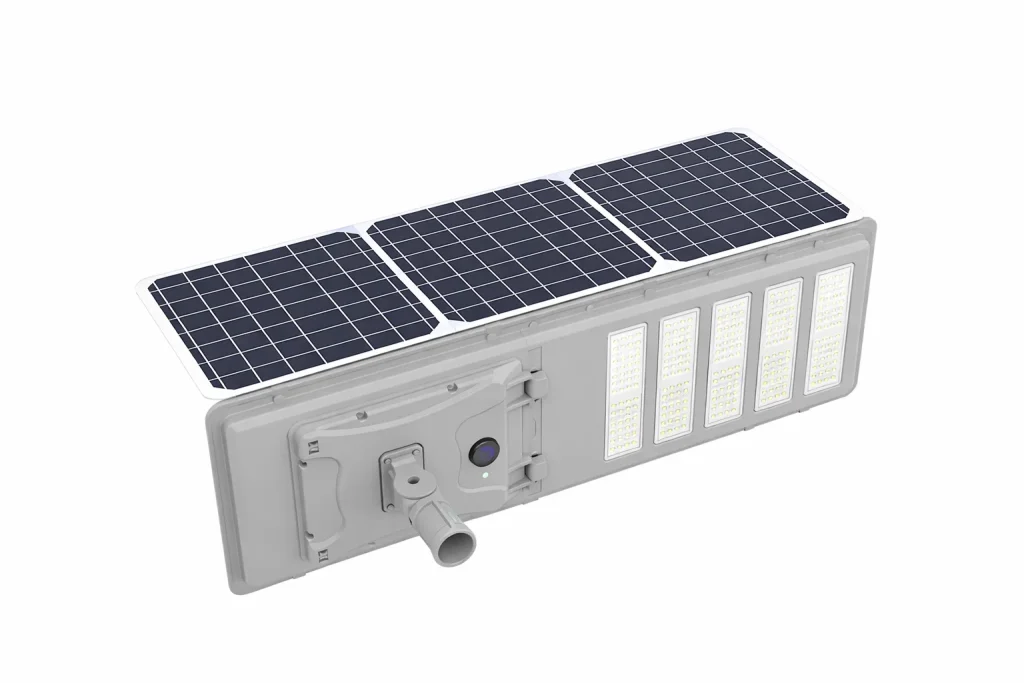
Solar LED street lights integrate a photovoltaic panel, battery storage, MPPT charge controller, and LED luminaire into a self-contained system requiring no grid connection. They are the correct solution for off-grid rural electrification, remote road sections where grid connection cost is prohibitive, and emergency lighting applications requiring grid independence.
The most critical specification in a solar street light is the battery chemistry. LiFePO4 (lithium iron phosphate) is the only recommended battery chemistry for commercial solar street light installations — it offers 2,000–3,000 charge cycles versus 500–800 cycles for lead-acid, operates safely from -20°C to +60°C, and has zero thermal runaway risk. Any solar street light specification using lead-acid, gel, or unspecified “lithium” batteries should be treated with caution.
LED Street Light Housings

For OEM buyers, module replacement projects, or custom luminaire design, LED street light housings are available as a standalone product — die-cast ADC12 aluminium housing with integrated heatsink, pre-wired driver compartment, and optical mounting points, supplied without LED module or driver. This allows buyers to specify their preferred LED component brand while using our housing’s thermal management and IP protection engineering.
Chapter 5: Photometric Optic Types Explained — Type II, III, IV, V
The optic type of an LED street light is as important as its wattage — yet it is the specification that most procurement documents omit entirely. Specifying the wrong optic for a road configuration wastes 30–40% of the luminaire’s light output on non-road surfaces, making the installation less energy-efficient and potentially non-compliant with the applicable lighting standard regardless of wattage.
The IES (Illuminating Engineering Society) classifies road lighting distributions into five types:
Type II produces a narrow, elongated distribution pattern extending along the road axis. It is the correct optic for wide roads where the pole is positioned at one side of the carriageway and the light must reach across the full road width. Single-side pole arrangements on roads up to 1.5x the mounting height wide typically use Type II.
Type III produces a medium forward-throw distribution — wider and more asymmetric than Type II, projecting light further forward along the road axis. This is the most commonly specified optic for arterial road, main road, and collector road applications with single-side or staggered pole arrangements.
Type IV produces a strong forward-throw distribution for applications where the pole is at the very edge of the carriageway and light must be thrown primarily in one direction. Used for roadway edges, building perimeters, and parking access roads.
Type V produces a symmetric, circular distribution — equal light output in all directions. This is the correct optic for intersections, roundabouts, town squares, and any application requiring uniform coverage in multiple directions rather than directional road illumination.
All Sinocoled Series VEGA products are available with Type II, III, IV, and V optic configurations. We provide free photometric simulation to confirm the correct optic type for your specific road geometry before specification is finalised.
Chapter 6: Smart Controls — What Is Worth Specifying in 2026
Smart lighting control for LED street lights has moved from a premium option to a baseline expectation in municipal procurement globally. But the smart controls landscape is confusing, with multiple competing standards, protocols, and proprietary platforms that can make specification decisions genuinely difficult.
Here is an honest guide to what matters and what doesn’t in 2026.
DALI2 and DALI2 D4i — The Standard That Matters Most
DALI (Digital Addressable Lighting Interface) is a digital dimming and control protocol that allows individual luminaire addressing over a shared two-wire bus. DALI2 is the current generation, and DALI2 D4i is the most advanced implementation — it adds luminaire-level energy metering, fault reporting, and driver status monitoring directly through the DALI bus without additional hardware.
For any project where energy accountability, predictive maintenance, or asset-level performance monitoring is a requirement, DALI2 D4i is the correct specification. Sinocoled Series VEGA 100W and above include DALI2 D4i drivers as standard.
0-10V Dimming
The simplest and most widely compatible dimming interface. An analogue control signal between 0V (minimum output) and 10V (full output) adjusts the luminaire’s light level proportionally. It is reliable, inexpensive, and compatible with virtually all control systems. The limitation is that it does not support individual luminaire addressing or fault reporting.
For projects without smart city infrastructure requirements, 0-10V dimming provides excellent energy savings at minimal system cost. All Sinocoled products support 0-10V as standard.
NEMA Socket (3, 5, 7 Pin)
The NEMA photocell socket — originally designed for plug-in photocell sensors — has been adopted as the de facto hardware interface for smart city control nodes in North America and increasingly globally. A smart control node (from manufacturers including Telensa, Itron, Echelon, and others) plugs directly into the NEMA socket on the luminaire without any wiring modification, enabling wireless CMS connectivity without touching the driver or housing.
The 7-pin NEMA socket (also called ANSI C136.41) adds a DALI communication channel to the standard power and photocell contacts, enabling direct driver control through the smart node rather than through analogue 0-10V. For smart city projects in North America, the 7-pin NEMA is the correct specification.
ZHAGA Book 18 Socket
ZHAGA Book 18 is the European-origin equivalent of the 7-pin NEMA — a standardised socket on the luminaire that accepts interchangeable smart control nodes from any ZHAGA-certified manufacturer. It is increasingly specified in European municipal tenders as the preferred interface for future-proofing smart city control integration.
Sinocoled Series VEGA products support both NEMA 7-pin and ZHAGA Book 18 as standard options — ensuring compatibility with any smart city control platform regardless of regional standard.
LoRaWAN and ZigBee
These are wireless network protocols used for city-wide smart street light control without dedicated copper communication wiring. LoRaWAN operates on sub-GHz frequencies with range up to 15 kilometres from a single gateway — making it cost-effective for large municipal networks with widely spaced infrastructure. ZigBee operates at 2.4GHz with range up to 100 metres per node, forming a mesh network that extends coverage by routing signals between luminaires.
Both protocols are mature, well-supported, and genuinely suitable for street light control. The choice between them depends on your city’s existing IoT infrastructure and your CMS vendor’s preferred protocol. Sinocoled intelligent street lights support both LoRaWAN and ZigBee as firmware options in the same hardware platform.
Chapter 7: Total Cost of Ownership — The Calculation Every Buyer Must Run
The purchase price of an LED street light is the smallest part of its total cost over a 20-year project life. Understanding the full total cost of ownership (TCO) is what separates an informed procurement decision from a budget-driven mistake.
Here is the TCO framework we use with every large-scale client:
Energy Cost
Energy cost typically accounts for 70–80% of the total lifetime cost of a street light installation. At $0.12 per kWh (a conservative global average for grid electricity), a single 100W street light running 12 hours per night consumes 438 kWh per year — costing approximately $52.56 annually per luminaire.
Replace that 100W legacy HPS fitting with a 60W Sinocoled VEGA-60 delivering equivalent lumens at 160 lm/W, and the annual energy cost drops to $31.54 — a saving of $21 per luminaire per year. Across a 1,000-luminaire municipal project, that is $21,000 in annual energy savings. Over 20 years (without accounting for energy price inflation), the saving exceeds $420,000 — from a product upgrade that may cost $80,000 more upfront than continuing with HPS.
This is why efficacy is the most important specification. Every additional lm/W of efficacy reduces the 20-year energy cost of the installation.
Maintenance Cost
LED street lights have a significantly lower maintenance cost profile than HPS because they do not require lamp replacement every 18,000–25,000 hours. A typical HPS lamp replacement programme for a 1,000-luminaire network involves a full relamping every 4–5 years — including lamp cost, scissor lift or cherry picker hire, labour, and traffic management, which can easily total $150–$300 per luminaire per cycle.
A quality LED street light with L70 ≥ 50,000 hours and a 3-year warranty on driver and housing components eliminates this relamping cycle entirely for 10–15 years. With smart controls providing real-time fault detection, reactive maintenance is also reduced — failed luminaires are identified and reported automatically rather than discovered by residents or during scheduled night inspections.
Capital Cost
Capital cost includes the luminaire purchase price, installation labour, pole and cable infrastructure (if new), and commissioning. For retrofit projects replacing existing poles and infrastructure, luminaire cost and installation labour dominate.
For a quality LED street light from a certified manufacturer with full documentation — CE, ENEC, LM-79, LM-80 — the price range in 2026 is approximately $45–$180 per luminaire depending on wattage, features, and order volume. This is the range where Sinocoled’s factory-direct pricing with no minimum order quantity provides meaningful cost advantage over brands that sell through distribution chains adding 30–60% margin at each stage.
Warranty and Risk
A 3-year warranty from a verifiable manufacturer with a physical facility, traceable production records, and accessible after-sales support represents a fundamentally different risk profile from a 5-year warranty printed on a datasheet from a supplier with no address and no verifiable factory.
Sinocoled offers a 3-year warranty on all Series VEGA products with a direct after-sales team at our Shenzhen facility. We maintain production records for every batch by serial number — allowing any failed component to be traced to its production date, raw material batch, and assembly line for root cause analysis.
Chapter 8: How to Evaluate a Manufacturer vs a Trading Company
This is the question that determines whether the product you receive matches what was specified — or whether you discover the difference after installation.
In the LED street light supply chain, the distinction between a genuine manufacturer and a trading company (or agent) matters enormously. A trading company sources products from one or more factories, adds its own brand and documentation, and sells them to buyers who believe they are purchasing directly from a manufacturer. This is not inherently dishonest — but it means the buyer has no direct relationship with the entity that actually made the product, no visibility into the real production quality controls, and no recourse if the product fails and the trading company closes.
Here are the specific questions and verification methods I recommend to every buyer:
Ask for the factory address and visit it, or hire a third-party inspection firm to visit it. A genuine manufacturer will provide a specific factory address (not just a city), allow factory visits, and support third-party pre-shipment inspections. A trading company will often deflect this request or claim the factory location is confidential.
Request the ISO 9001 certificate with the factory’s legal entity name and address. Compare the legal entity name on the ISO certificate with the entity name on the supplier’s quotation and invoice. If they differ — and the supplier cannot explain why — you are likely dealing with a trading company presenting another factory’s certification as its own.
Ask for batch production records for the specific products in your order. A real manufacturer can provide QC inspection records by production date, serial number range, and batch code for any order. A trading company cannot — because it does not have access to the factory’s internal records.
Request a factory audit or live video walkthrough. We welcome factory visits and conduct live video audits for international buyers who cannot travel to Shenzhen. We show the production floor, the testing laboratory (including our integrating sphere for LM-79 measurement), and the quality control station where finished products are tested before packing.
At Sinocoled, we are the factory. Our Shenzhen facility covers 5,000 square metres at Building G, Shasi Hi-Tech Park, Shajing Town, Baoan District, Shenzhen, Guangdong, China. Every product we sell is manufactured, tested, and documented at this facility by our own production team.
Chapter 9: Step-by-Step LED Street Light Specification Checklist for 2026
This is the practical checklist I give to every new client before they finalise a project specification. Work through every point before accepting any supplier’s proposal.
Step 1 — Define the road classification and applicable lighting standard. Confirm the EN 13201 class (for European projects), ANSI/IES RP-8 category (for North American projects), or AS/NZS 1158 category (for Australian/NZ projects) before selecting any product. The lighting standard determines your target lux level — and the target lux level determines your required lumen output. Everything else follows from this.
Step 2 — Record road geometry. Measure and document road width, pole mounting height, and pole spacing. If these are not yet finalised, work backwards from the available product wattage range — narrower pole spacing allows lower wattage luminaires at the same lux level.
Step 3 — Calculate required lumen output. Use the formula: Required lumens = (Road width × Pole spacing × Target lux) ÷ Maintenance factor ÷ Utilisation factor. Use our free LED street light wattage calculator at sinocoled.com for instant results. Confirm with a full photometric simulation for any project above 50 luminaires.
Step 4 — Specify minimum efficacy alongside wattage. Every specification document should read “100W minimum, ≥150 lm/W confirmed by IES LM-79 test report” — not just “100W LED street light.”
Step 5 — Specify IP, IK, and surge protection. Minimum IP65 / IK08 for residential. IP66 / IK10 / 10kV surge protection for arterial and highway applications. IP66 / IK10 / 20kV (ANSI C136.2-2023 Extreme) for exposed highway and coastal installations.
Step 6 — Specify CCT and CRI. 4000K / CRI 70 for standard road applications. 3000K for residential and dark-sky sensitive areas. CRI 80 for pedestrian priority zones and CCTV-critical locations.
Step 7 — Specify optic type. Type III is standard for most arterial applications. Type II for wide roads with single-side poles. Type V for intersections and roundabouts. Always confirm with photometric simulation.
Step 8 — Specify dimming and control interface. 0-10V as minimum. DALI2 D4i for smart city metering. NEMA 7-pin or ZHAGA Book 18 for future smart node compatibility.
Step 9 — Request test documentation. LM-79 test report (complete luminaire, not LED chip), LM-80 + TM-21 lumen maintenance data, CE Declaration of Conformity with Notified Body reference, ENEC certificate if European tender, DLC QPL listing if North American project.
Step 10 — Verify manufacturer credentials. ISO 9001 certificate (legal entity name matches supplier), factory address, willingness to support third-party inspection, and warranty terms with after-sales contact information.
Chapter 10: Sinocoled Series VEGA — Built for Every Road Type and Every Market
We have spent this entire guide giving you the knowledge to evaluate any LED street light from any manufacturer — including us. Now let me tell you specifically what we built the Series VEGA range to deliver, and where it fits in the market.
Series VEGA covers 30W to 300W in a single coherent product family. Every model in the range shares the same ADC12 die-cast aluminium housing with integrated heatsink engineering, the same driver platform supporting 0-10V, DALI, and DALI2 D4i, and the same optic platform with Type II, III, IV, and V available across all wattages. This means a specifier who uses Series VEGA across a multi-zone project — residential streets, collector roads, and arterial roads — uses a single documentation package, a single photometric library, and a single procurement relationship.
The VEGA-30 through VEGA-80 range (IP65 / IK08) covers residential and collector road applications at efficacies from 155–165 lm/W. The VEGA-100 through VEGA-200 range (IP66 / IK10) covers arterial, dual carriageway, and highway applications at 160–170 lm/W. The VEGA-250 and VEGA-300 (IP67 / IK10) cover high-mast, interchange, and special infrastructure applications at 155–160 lm/W.
All Series VEGA products ship with CE, RoHS, and CB certificates as standard. ENEC is available on specified models. LM-79 and LM-80 reports are available for all models. DLC test data is available for V6.0 qualification assessment. IES and LDT photometric files are provided for all models at no charge.
Our minimum order quantity is zero. You can order one sample this week or a 10,000-unit container. Sample lead time is 1–7 working days for standard configurations. Bulk production lead time is 10–15 working days. We offer a 3-year warranty on all products with direct after-sales support from our Shenzhen engineering team.
Frequently Asked Questions
What is the best LED street light for a residential road?
For a standard residential road with 5–8 metre carriageway width, 6–8 metre mounting height, and 25–30 metre pole spacing, a 30W–50W LED street light delivering 4,500–8,000 lumens at ≥150 lm/W efficacy and a Type III optic typically achieves EN 13201 Class ME5 or Class P compliance. Confirm with a photometric simulation for your specific geometry. The Sinocoled Series VEGA-30 and VEGA-50 are the standard recommendation for this application.
How do I know if a Chinese LED street light manufacturer is genuine?
Request the ISO 9001 certificate with the factory’s legal entity name and physical address. Compare the name on the certificate with the entity on the quotation. Request factory audit access or a live video walkthrough. Ask for batch production records for a specific order. Any manufacturer who deflects all of these requests without explanation warrants careful evaluation. Sinocoled welcomes factory visits and third-party inspections at our Shenzhen facility.
What certifications do I need for LED street lights in Europe?
CE marking is the legal minimum for European market access. For municipal and government tenders, ENEC certification is increasingly specified and in many cases required. CB scheme certification enables efficient multi-market documentation. All Sinocoled Series VEGA products hold CE, RoHS, and CB as standard. ENEC is available on specified models.
What is DLC SSL V6.0 and does it affect my product selection?
DLC SSL V6.0 is the updated performance standard from the DesignLights Consortium that took effect in January 2026 for North American markets. It raises minimum efficacy thresholds by an average 14% and mandates dimming capability down to 20% for standard listings and 10% for premium listings. All Sinocoled Series VEGA products at 150–180 lm/W exceed the new thresholds. For USA and Canada projects requiring utility rebate qualification, confirm DLC V6.0 listing status with your Sinocoled account manager.
How long do LED street lights last?
Quality LED street lights with L70 ≥ 50,000 hours ratings last 11–14 years of nightly operation at 10–12 hours per night before reaching 70% of their initial lumen output — at which point many projects schedule luminaire replacement or driver upgrade. Premium configurations at L80 ≥ 60,000 hours extend this to 16–18 years. The LED module itself rarely fails first — driver failure and lens yellowing from UV exposure are the more common end-of-life modes in correctly installed LED street lights.
What is the difference between DALI and DALI2 D4i?
DALI is the original digital dimming protocol allowing individual luminaire addressing and dimming control over a shared bus. DALI2 is the updated standard with improved interoperability and additional device classes. DALI2 D4i adds luminaire-level energy metering and fault reporting directly through the DALI bus — enabling asset-level performance monitoring without additional metering hardware. For smart city projects where energy accountability and predictive maintenance are priorities, DALI2 D4i is the correct specification.
Can I get a free photometric simulation from Sinocoled before ordering?
Yes — for any project of any size. Submit your road width, mounting height, pole spacing, required lighting class, and ute arrangement to our engineering team and we return a full DIALux EVO or AGi32 simulation report with false-colour lux map, EN 13201 compliance check, and product recommendation within 48 hours. Contact us at sinocoled.com/free-lighting-design.
What is the minimum order quantity from Sinocoled?
We operate with no minimum order quantity. You can order a single sample or a full container — the same product quality, the same documentation package, and the same production standards apply to every order regardless of size. Sample lead time is 1–7 working days. Bulk production lead time is 10–15 working days.
Related reading: how the major street light manufacturers compare on efficacy, L70 and surge protection.