

Search for an LED street light supplier and you will find no shortage of candidates — a handful of global names that municipalities have specified for decades, and several hundred Chinese factories quoting a fraction of the price. The hard part is not finding suppliers. It is working out which published specifications survive contact with a real road, a real ambient temperature and a real ten-year maintenance budget.
Key takeaways
- Tier-1 luminaire efficacy has converged around 120–170 lm/W, with the upper end of published road-and-street ranges reaching roughly 220 lm/W — but efficacy alone stopped being the differentiator once controls entered the specification.
- The numbers that actually predict field performance are LM-79 (measured luminaire output), LM-80 plus TM-21 (projected L70 lifetime), the BUG rating under IES TM-15, and the surge withstand level.
- For pole-mounted roadway lighting, ANSI C136.2 high-exposure conditions call for 10 kV / 10 kA surge protection. A 6 kV / 3 kA device is a low-exposure part being sold into a high-exposure application.
- A 50,000-hour L70 is the practical minimum for a 2026 municipal project — roughly 11–14 years at 10–12 hours a night.
- SINOCO manufactures street, roadway and area luminaires in China with OEM and ODM programmes, including high-efficacy platforms in the 200–220 lm/W class.

The Competitive Landscape in 2026
The market splits into three tiers with genuinely different propositions, and a buyer who compares across tiers on price alone will always reach the wrong conclusion.
| Tier | Representative names | Core proposition | Where it struggles |
|---|---|---|---|
| Global majors | Signify (Philips), Acuity Brands / American Electric Lighting, Schréder, Cree, GE Current, Hubbell | Specification depth, controls ecosystems, long institutional track record, local service | Unit cost, lead time on custom configurations, minimum project scale |
| Established China OEM/ODM | SINOCO and comparable ISO-certified factories | Direct factory pricing, deep customisation, high-efficacy platforms, own tooling | Requires the buyer to specify properly and verify claims |
| Trading companies and marketplace sellers | Unbranded Alibaba listings | Lowest quoted price, no MOQ friction | No design control, no test reports, silent BOM substitution, no warranty path |
Signify is the largest by revenue and global footprint, operating in more than 70 countries with over 25 named road-and-street product families — ClearWay gen2, Philips Iridium gen4, DigiStreet, RoadForce and SmartBright Road among them — with published efficacy spanning roughly 104 to 220 lm/W depending on family and configuration. Acuity Brands, through American Electric Lighting, is the dominant name in large North American institutional projects and one of a small group of US-headquartered manufacturers with domestic production. Schréder and Cree hold strong positions in municipal and high-efficacy commercial work respectively.
The more important observation is structural: smart-control integration has shifted the competitive line from raw luminaire efficacy toward software, controls and system management. Two luminaires at 160 lm/W are, for practical purposes, the same light. What differs is whether the controls layer works, whether the photometric distribution suits your road cross-section, and whether the fixture survives a decade of thermal cycling and surges.

The Five Specifications That Decide Field Performance
1. Efficacy — and which efficacy figure you are being quoted
This is the single most common place buyers are misled, usually without anyone lying. There are three different numbers that all get called “efficacy”:
- LED package efficacy — from the chip manufacturer’s datasheet, measured at 25 °C junction temperature and low drive current. Always the highest number. Not achievable in a finished product.
- Module efficacy — the LED board with its optics, still excluding driver losses.
- Luminaire efficacy (LM-79) — the complete fixture, at rated drive current, at operating temperature, including driver losses and optical losses. This is the only figure that predicts how many lumens land on the road per watt from the grid.
The gap between package and luminaire efficacy is routinely 25–35%. When a specification sheet states an efficacy without naming LM-79, assume you are reading a module or package figure until a test report says otherwise. Ask for the LM-79 report, from an accredited laboratory, for the exact SKU and configuration you are buying — not for a sibling model.
2. Lifetime — L70, and why the hours figure on its own means nothing
LM-80 measures lumen depreciation of the LED package or module across multiple case temperatures over a minimum of 6,000 test hours. TM-21 then extrapolates that data to project service life, and the accepted limit of that extrapolation is six times the tested hours. L70 is the point at which output has fallen to 70% of initial lumens.
Three things follow that buyers routinely miss:
- An L70 claim without a temperature is meaningless. L70 at 25 °C and L70 at 55 °C case temperature are very different numbers for the same LED. Ask which In-Situ Temperature Measurement Test (ISTMT) result the projection is based on.
- TM-21 cannot honestly project beyond 6× the test hours. A 100,000-hour claim from 6,000 hours of LM-80 data exceeds what the method supports.
- LM-80 covers the LED, not the driver. Drivers are the most common field failure in street lighting, and no LM-80 report says anything about them. Ask for the driver brand, model and its own rated life at the actual operating case temperature.
For a 2026 municipal specification, 50,000 hours L70 is a reasonable floor — about 11 to 14 years at 10 to 12 hours a night.
3. Photometrics — distribution beats lumens
A 150 W fixture with the wrong distribution will light a road worse than a well-chosen 100 W one, and will cost more to run. What matters:
- IES LM-63 photometric files (.ies) for every SKU, so your lighting designer can model the actual installation rather than guess.
- Distribution type — IES Type II, III, IV or V, matched to road width, pole setback and mounting height.
- Uniformity to the governing standard — EN 13201 in Europe, ANSI/IES RP-8 in North America — expressed as average-to-minimum and maximum-to-minimum ratios, not just average lux.
- BUG rating under IES TM-15 — Backlight, Uplight and Glare, each scored 0 to 5 with 0 best. Dark-sky-conscious specifications require U0, meaning zero uplight.

4. Surge protection — the cheapest insurance in the fixture
Pole-mounted roadway luminaires sit on long exposed feeders and are classified under IEEE C62.41.2 Category C, high exposure. ANSI C136.2 sets the dielectric withstand and transient immunity requirements; its enhanced test level correlates with that Category C high-exposure environment. The practical translation:
| Protection level | Exposure category | Typical application |
|---|---|---|
| 6 kV / 3 kA | Low exposure | Indoor or short, protected feeders |
| 10 kV / 10 kA | High exposure | Pole-mounted roadway and area lighting |
| 20 kV / 10 kA | Severe exposure | Lightning-prone regions, long rural feeders, elevated sites |
A quoted “surge protection: yes” is not a specification. Require the level, the standard it is tested to, and whether the SPD is replaceable in the field or fails the whole luminaire with it. On a several-thousand-pole project, a replaceable external SPD module changes the ten-year maintenance cost materially.
5. Thermal and mechanical construction
- Housing and heat path — die-cast aluminium alloy with a designed thermal path from LED board to housing. Ask for the LED board case temperature at rated power in a 40 °C ambient; that number drives every lifetime claim in the document.
- Ingress and impact — IP66 as a minimum for the optical and driver compartments, IK08 or better for impact. Require the test report, not the marking.
- Driver access — tool-less access matters over a 15-year life; a sealed fixture means a full replacement on the first driver failure.
- Corrosion — salt-spray hours for coastal projects, and a stated coating system rather than “powder coated”.
- Photocontrol receptacle — ANSI C136.10 locking-type compatibility if the network requires it, and whether a 7-pin receptacle is available for controls.
Certification: Which Marks Actually Matter
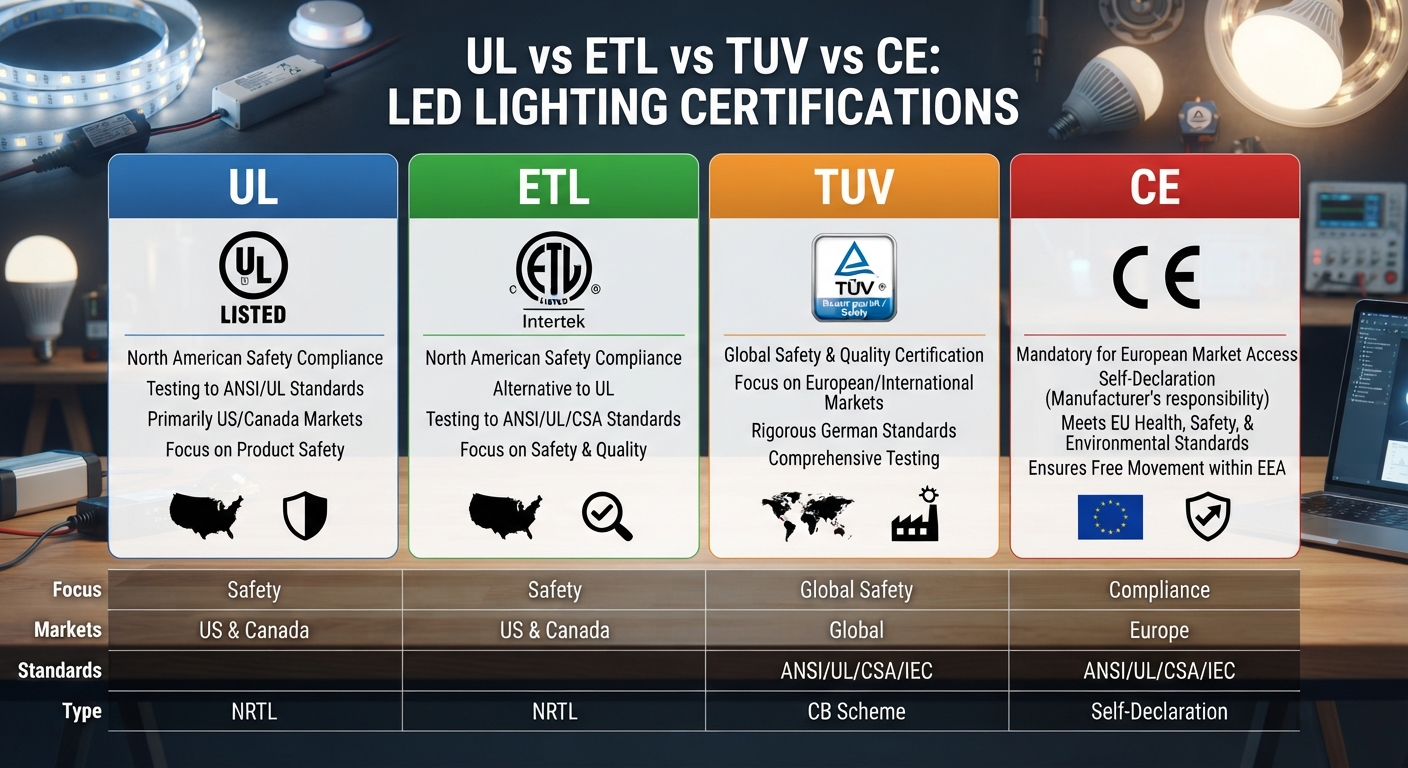
| Mark or listing | What it covers | Market |
|---|---|---|
| UL / ETL Listed | Product safety, tested by an NRTL | US and Canada |
| DLC QPL | Performance listing — efficacy, lifetime, warranty thresholds | US and Canada utility rebates |
| CE | Self-declared conformity with EU directives | EU |
| ENEC | Third-party tested European safety and performance | EU |
| TÜV | Third-party safety certification | Global |
| CB Scheme | Cross-recognised test report basis for national certifications | Global |
The distinction that costs buyers money: CE is a self-declaration, whereas ENEC and TÜV involve third-party testing. And DLC listing is a performance programme, not a safety approval — but on North American projects it is frequently the gate to utility rebates, which can move total project economics more than the fixture price does. If rebates are part of your business case, confirm the exact model number appears on the DLC Qualified Products List before ordering.
How to Run a Supplier Evaluation That Actually Works
The document set to request before any sample
- LM-79 report from an accredited lab, for the exact SKU and drive current.
- LM-80 report plus TM-21 projection, with the ISTMT case temperature stated.
- IES photometric files for every distribution you are considering.
- Surge protection datasheet with level, standard and replaceability.
- Driver manufacturer, model, and rated life at operating case temperature.
- Safety certification (UL/ETL/ENEC/TÜV) for the exact model, plus DLC listing if rebates apply.
- IP and IK test reports.
- Warranty terms in writing — duration, what it covers, who pays freight, and whether it survives the supplier’s own model changes.
The three questions that separate factories from traders
- “Who made the driver, and can I see its datasheet?” A factory answers immediately. A trader forwards the question.
- “What is the LED board case temperature at rated power in 40 °C ambient?” This requires a thermal measurement they either have or do not.
- “Can you supply the same SKU with a different photometric distribution?” Real manufacturing means optics are a configurable input, not a fixed catalogue item.

Commercial terms worth negotiating
Beyond unit price, the terms that move total cost of ownership: spare-part availability commitment, a defined obsolescence notice period, whether tooling is amortised or owned, batch-level test reporting, and a golden-sample retention agreement so that unit 5,000 can be checked against unit 1. Component substitution between orders is the most common quality failure in this category, and a contractual per-lot test report is the only practical defence.
Where SINOCO Fits
SINOCO manufactures LED street lights, roadway luminaires, intelligent street lighting and street light housings in China, with OEM and ODM programmes for brand owners, contractors and municipal distributors, and high-efficacy platforms in the 200–220 lm/W class.
For buyers who want to go deeper on individual decisions, our LED street light buying guide covers fixture selection end to end, the wattage guide works through sizing by road type, and the guide to identifying a genuine street light factory covers how to tell a manufacturer from a trading company during an audit.
Specifying a street lighting project? Send SINOCO your road geometry and target lux class and we will return a photometric layout, a wattage recommendation and the supporting test documentation — or browse the full LED street light range.
Frequently Asked Questions
What is a good efficacy for an LED street light in 2026?
Tier-1 manufacturers have largely converged in the 120 to 170 lm/W range, with the top of published road-and-street ranges reaching around 220 lm/W in specific configurations. What matters more than the number is whether it is a luminaire-level LM-79 measurement rather than an LED package datasheet figure, because the gap between those two is routinely 25 to 35 percent.
What is the difference between LM-79, LM-80 and TM-21?
LM-79 measures the complete luminaire’s photometric and electrical performance — total lumens, efficacy, power factor and colour — at the system level. LM-80 measures lumen depreciation of the LED package or module over at least 6,000 hours at multiple case temperatures. TM-21 is the method for extrapolating LM-80 data into a projected lifetime, valid to a maximum of six times the tested hours.
How many hours should an LED street light last?
For a 2026 municipal specification, 50,000 hours to L70 is a reasonable minimum, which is roughly 11 to 14 years at 10 to 12 hours a night. Always ask at which case temperature the L70 was projected, and remember that LM-80 and TM-21 describe the LED only — driver life is a separate question and drivers are the more common field failure.
What surge protection do street lights need?
Pole-mounted roadway lighting falls under IEEE C62.41.2 Category C high exposure, for which the recommended level is 10 kV / 10 kA. A 6 kV / 3 kA device is specified for low-exposure conditions and is under-rated for pole-mounted use. In lightning-prone regions, 20 kV / 10 kA is a reasonable step up. Also confirm whether the surge protector is field-replaceable.
What is a BUG rating?
BUG stands for Backlight, Uplight and Glare, defined by IES technical memorandum TM-15. Each of the three is scored from 0 to 5, with 0 being best. Backlight is light spilling behind the fixture, uplight is light going toward the sky and causing skyglow, and glare is brightness causing discomfort or hazard. Dark-sky-conscious specifications require a U0 rating, meaning zero uplight.
Is DLC certification the same as UL listing?
No. UL and ETL are product safety certifications issued by a nationally recognised testing laboratory. DLC is the DesignLights Consortium Qualified Products List, a performance programme covering efficacy, lifetime and warranty thresholds. A fixture can be UL listed without being DLC listed. DLC listing usually matters because North American utility rebate programmes require it.
How do I tell a real street light factory from a trading company?
Ask three questions that require manufacturing knowledge: who makes the driver and can you see its datasheet; what is the LED board case temperature at rated power in 40 °C ambient; and can the same SKU be supplied with a different photometric distribution. A factory answers all three directly. A trading company forwards the questions to someone else.
Why do quoted prices vary so much between suppliers?
Because the quotes are usually not for comparable products. The main cost drivers are the LED bin and driver brand, the surge protection level, housing mass and thermal design, ingress protection, and whether the fixture carries third-party safety certification for that exact model. A quote that is 40 percent below the field almost always differs on several of those simultaneously.
Conclusion
Street lighting is a fifteen-year purchase evaluated on a fifteen-minute quotation comparison, which is why so many projects underperform. The correction is not complicated: insist on LM-79 at the SKU level, tie every lifetime claim to a stated case temperature, model the installation from real IES files, match surge protection to the actual exposure category, and put per-lot verification into the contract.
Do that and supplier tier stops being a proxy for quality, because you are buying against evidence instead of reputation.