

If you have ever spent hours scrolling through Alibaba listings, shortlisting three suppliers, only to receive a product that looked nothing like the sample — you already know the pain. I have been through that cycle more than once, and I am writing this guide so you do not have to repeat my mistakes.
Sourcing LED street lights from a wholesale supplier in China is not as simple as picking the cheapest quote. In 2026, the market is more competitive, more technically sophisticated, and frankly, more saturated with middlemen than ever before.
LED Street Light Wholesale Supplier China: The Complete Sourcing Guide
This guide covers everything — from how to evaluate a genuine LED street light manufacturer in China, to the certifications you must demand, the wattage and efficacy benchmarks that matter today, and the red flags that tell you a supplier is a trading company pretending to be a factory. By the end of this article, you will not need to go back to the search engine. Everything is here.
Why China Remains the Global Hub for LED Street Light Wholesale
Let us address the fundamental question first. Why China?
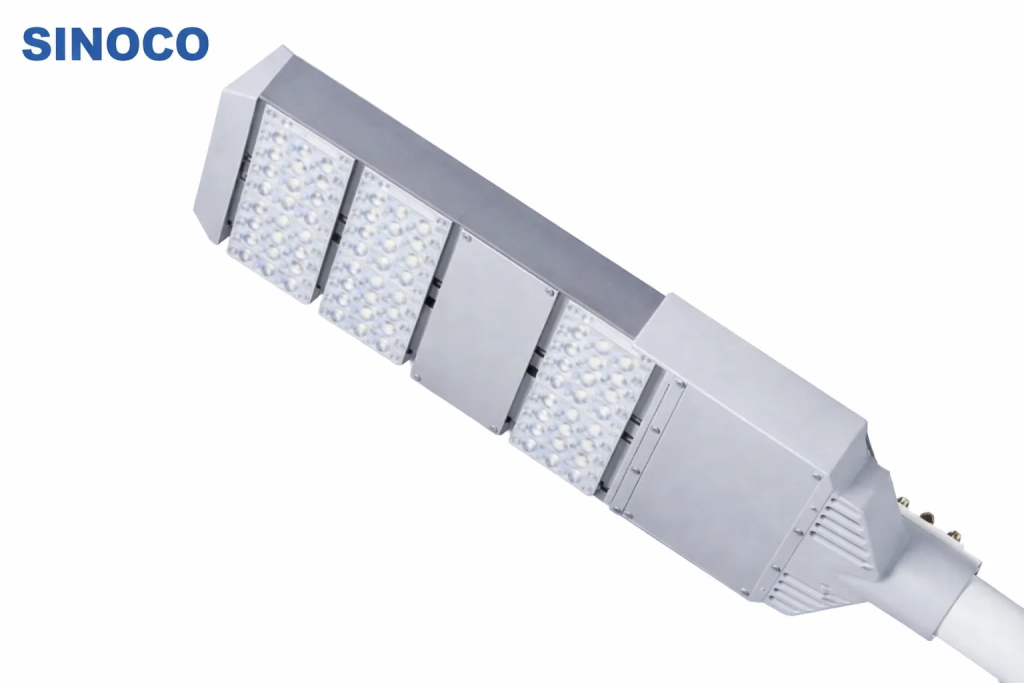
The answer is not just cost — it is ecosystem density. Shenzhen, Zhongshan (Guzhen Town), and Guangzhou collectively house more LED component manufacturers, LED chip suppliers, driver manufacturers, and housing die-casters than the rest of the world combined. When a supplier like SINOCO (sinocoled.com) says their 5,000 sqm Shenzhen facility has access to Nichia chips, Mean Well drivers, and ADC12 aluminum housings within the same industrial district, that is not marketing language — that is a genuine supply-chain advantage that no factory in Europe or North America can replicate at the same cost point.
For wholesale buyers — whether you are a municipal procurement officer, an EPC contractor, a regional distributor, or a private-label brand — China’s LED street light ecosystem gives you access to:
- Wattages from 30W to 400W+ under one roof
- Efficacy figures now reaching 200 LM/W (a benchmark that was 160 LM/W just four years ago)
- Full OEM and ODM customization, including your own branding, lens design, and CCT
- Global compliance certifications: CE, TUV, ETL, DLC, SAA, PSE, RoHS, and more
- Direct factory pricing that undercuts regional distributors by 30–60%
The challenge is not finding a supplier. The challenge is finding the right supplier. Let me walk you through how we approach this.
What Actually Separates a Manufacturer from a Trading Company
This is the single most important thing I want you to understand before you place any inquiry.
When you search “led street light wholesale supplier China,” roughly 70% of the results — whether on Alibaba, Made-in-China, or even Google — are trading companies. They source from actual factories, add a margin, and present themselves as manufacturers. There is nothing inherently wrong with that business model, but if you are buying wholesale at volume, you are paying for an unnecessary layer in the chain.
Here is how I verify a genuine manufacturer:
1. Factory audit video or live virtual tour. A real manufacturer can show you their production line, SMT assembly, aging room (the room where LED modules are tested under load before shipping), and their LM-80 testing setup. A trading company cannot.
2. Patents. Genuine LED street light manufacturers in China hold patents — on optical designs, thermal management structures, or smart-control integration. SINOCO, for instance, holds over 20 national patents. Ask to see the patent certificates.
3. Certifications issued to the company, not the product. This is subtle but important. ISO 9001 is a management system certificate issued to the organization. If a supplier can only show you a CE certificate on a specific product but cannot show an ISO certificate with their company name, that is a yellow flag.
4. Minimum order quantities. Factories typically have MOQs because their production runs are batch-optimized. Trading companies are often more flexible because they aggregate orders from multiple buyers. If a “manufacturer” tells you they can do 1 unit with your logo on it, ask more questions.
5. In-house R&D. Manufacturers iterate. They have engineering teams. Ask them about their latest product development — what changed in their latest luminaire revision, and why. If they cannot answer technically, you are talking to a reseller.
The 2026 Technical Benchmarks You Must Know Before Sourcing
The LED street light market has moved faster in the last three years than in the preceding decade. Here are the specifications that matter in 2026, and why settling for anything less is leaving money on the table.
Luminous Efficacy: The Single Most Important Number
In 2020, a “good” LED street light achieved around 140–160 lm/W. By 2023, 180–200 lm/W became the benchmark for premium LED lighting solutions. In 2026, up to 200 lm/W represents the highest efficiency achieved by leading commercial manufacturers using advanced LED technology, delivering exceptional energy savings and long-term performance.
Why does this matter for a wholesale buyer? Because the wattage you specify for a project is directly tied to the efficacy of the luminaire. A 100W fixture at 200 LM/W delivers 20,000 lumens — the same output that previously required a 150W fixture at 173 LM/W. Over a network of 1,000 street lights running 12 hours a night, that difference compounds into hundreds of thousands of dollars in electricity savings over a 10-year lifespan.
When evaluating a Chinese LED street light wholesale supplier, always ask for the LM-80 test report (which measures lumen depreciation over time) and the IES photometric file (which tells you the actual light distribution on the road surface, not just the raw lumen output).
IP Rating: IP65 vs IP66 vs IP67 — Know the Difference

For road-facing luminaires, the minimum acceptable IP rating is IP65 (dust-tight, protected against water jets from any direction). However, in coastal environments, areas with heavy monsoon rainfall, or where pressure washing of fixtures is standard practice, IP66 is the correct specification.
I have seen projects where IP65 fixtures were installed in Malaysian coastal highways and failed within 18 months due to salt ingress. IP66 or better should be your default for any outdoor road lighting project in challenging climates.
IK Rating: Why Impact Resistance Matters in Urban Deployments
IK ratings measure mechanical impact resistance. IK08 is standard for most street light housings; IK10 (the maximum rating, resistant to 20-joule impacts) is what you want for high-vandalism areas or sports venue flood applications. Ask your Chinese supplier whether their housing is IK-rated and at which level — most will not volunteer this information unless you ask.
CCT (Correlated Color Temperature): Getting It Right for the Application
This is where many buyers make expensive mistakes. The two dominant choices for LED street lights are:
- 4000K (Neutral White): The global standard for most municipal road lighting. Provides good color rendering, reduces sky glow, and is endorsed by the American Medical Association’s guidelines on limiting blue-spectrum light at night.
- 5000K (Cool White / Daylight): Higher perceived brightness at the same lumen output due to photopic vs mesopic vision effects. Common in industrial zones, parking areas, and ports. Not recommended for residential streets.
- 3000K (Warm White): Used in historic districts, residential neighborhoods, and hospitality areas where aesthetic warmth is prioritized over pure illumination efficiency.
Always specify CCT in your purchase order. Do not leave it to the supplier’s default.
Smart Controls and the NEMA/Zhaga Interface
In 2026, any wholesale LED street light supplier worth their salt should be offering luminaires with a NEMA socket (7-pin) or Zhaga Book 18 interface as standard or optional. These sockets allow you to plug in a wireless node — a small device that connects each luminaire to a central management system (CMS) for remote dimming, fault detection, and energy monitoring.
If a supplier’s product does not support either NEMA or Zhaga connectivity, you are buying infrastructure that will be obsolete within five years. Municipal clients in Europe, North America, and increasingly Southeast Asia are now mandating smart-ready luminaires for all new road lighting tenders.
Certifications: The Non-Negotiables for Global Wholesale Distribution
One of the biggest sourcing mistakes I see is buyers accepting certificates at face value without verifying them. Here is what you need for each major market:
European Union: CE marking (mandatory), RoHS compliance (mandatory), TUV or ENEC (premium, adds market credibility), CB certificate (enables mutual recognition in 60+ countries).
North America: ETL listing (for the US and Canada, equivalent to UL but faster), DLC (DesignLights Consortium) qualification (required for most utility rebate programs in the US — this is non-negotiable if your customers are applying for rebates), FCC Part 15 (for any luminaire with built-in wireless/smart functionality).
Australia / New Zealand: SAA mark (Standards Australia Association).
Japan: PSE mark (mandatory for products sold in Japan).
A supplier like SINOCO covers all of these — their product portfolio carries TUV, ENEC, CB, CE, RoHS, ETL, DLC, SAA, and PSE certifications. When a manufacturer holds this breadth of certifications, it signals that they have been through the rigorous third-party testing process for multiple markets, which is a strong proxy for overall product quality.
How to verify: Every DLC-listed product can be verified on the DLC QPL (Qualified Products List) at designlights.org. CE and TUV certificates have unique certificate numbers that can be verified with the issuing body. Never accept a certificate that cannot be verified online.
How to Evaluate an LED Street Light Wholesale Supplier in China: My Step-by-Step Process
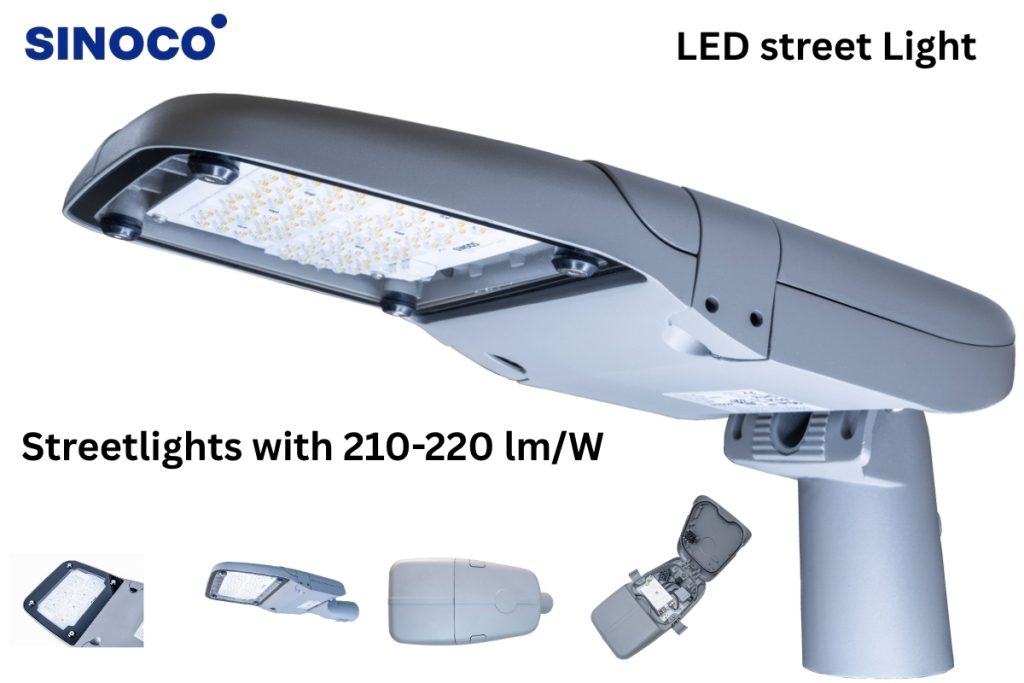
After years of sourcing from Chinese LED manufacturers, here is the exact process I use when evaluating a new supplier:
Step 1 — Request the Technical Data Sheet (TDS) and IES file. These two documents tell you almost everything. If a supplier cannot provide an IES file, their photometric data is not independently verified.
Step 2 — Ask for the LM-80 and TM-21 reports. LM-80 is the IESNA standard for measuring lumen depreciation of LED packages over time (minimum 6,000 hours of data). TM-21 extrapolates that data to project L70 lifespan (the point at which lumen output drops to 70% of initial output). A legitimate 50,000-hour rated luminaire must have the TM-21 report to back it up.
Step 3 — Request a sample before any bulk order. Non-negotiable. I always pay for samples — suppliers who offer “free samples” with shipping cost covered are often trying to rush you into a bulk commitment before you have properly evaluated the product.
Step 4 — Conduct or commission a third-party factory audit. SGS, Bureau Veritas, and Intertek all offer factory audit services in China for a few hundred dollars. For orders above $50,000, this is money extremely well spent.
Step 5 — Check their export history. Platforms like Panjiva and ImportGenius let you verify a supplier’s actual shipping history — which countries they export to, at what volume, and how frequently. A manufacturer claiming to supply European municipalities but with no EU export history is a red flag.
Step 6 — Evaluate their engineering responsiveness. Send them a technical RFQ (Request for Quotation) with specific requirements — a particular wattage, a specific IES Type II or Type III distribution, a NEMA socket requirement. How quickly and accurately they respond tells you a great deal about their technical depth.
Pricing: What to Expect When Buying LED Street Lights Wholesale from China in 2026
Pricing varies enormously based on wattage, specification, certification requirements, and order volume. Here are realistic ranges as of mid-2026:
- 30W–60W LED street lights: $18–$45 per unit at wholesale (MOQ 100+ units)
- 80W–120W LED street lights: $40–$90 per unit
- 150W–200W LED street lights: $75–$150 per unit
- 250W–300W LED street lights (high-power roadway): $130–$220 per unit
These ranges assume standard specifications. DLC-listed products, NEMA-socket models, or luminaires with integrated surge protection above 10kV will be at the higher end of each range. Solar LED street lights (integrated photovoltaic panel, battery, and controller) will be significantly higher — typically $120–$350 per unit depending on solar panel wattage and battery capacity.
Negotiation leverage points: Sample order vs. bulk pricing, payment terms (L/C vs. T/T, 30% deposit vs. 50%), packaging (standard carton vs. custom branded packaging), and annual volume commitment agreements.
Solar LED Street Lights: The Fastest-Growing Wholesale Category in 2026
No guide to LED street light wholesale from China in 2026 is complete without addressing the solar segment. We are seeing solar LED street lights move from a niche product to a mainstream specification, particularly in:
- Sub-Saharan Africa (grid-unreliable environments)
- Southeast Asia (off-grid rural electrification programs)
- Middle East (government sustainability mandates)
- Latin America (municipal energy cost reduction programs)
The key technical evolution is the shift from lead-acid to lithium iron phosphate (LiFePO4) batteries, which offer a 2,000+ charge cycle life versus 500 cycles for lead-acid, meaning the battery outlasts the LED module itself in most deployments. Any solar LED street light supplier still shipping lead-acid systems in 2026 is selling you yesterday’s technology.
All-in-one solar street lights (where the panel, battery, controller, and LED module are integrated into a single unit) have also dramatically improved in reliability. The latest generation uses MPPT (Maximum Power Point Tracking) solar controllers that increase solar energy harvest efficiency by 15–20% compared to older PWM controllers.
Why SINOCO Is a Reference Supplier Worth Evaluating for Your Wholesale Needs
I want to be transparent: this guide is hosted on sinocoled.com, and I am going to explain why I think SINOCO is worth your serious evaluation — not as a blanket endorsement, but based on specific, verifiable criteria.
SINOCO (Shenzhen SINOCO Lighting Technologies Co., Ltd.) was established in 2005 — over two decades of operational history in the LED lighting manufacturing space. Their 5,000 sqm facility in Shenzhen’s Baoan District (Shasi Hi-Tech Park) is a genuine manufacturing operation, not a showroom for outsourced products.
What sets them apart in the current market:
200 LM/W efficacy — This is currently one of the highest commercially available efficacy figures in the LED street lighting industry, achieved through a combination of Nichia/Cree LED chip selection, advanced optical design, and precision thermal management.
ISO 9001, ISO 13485, ISO 14001, and ISO 45001 certifications — The ISO 13485 (Medical Device Quality Management) is particularly notable. A company that can meet medical device manufacturing standards has a quality management discipline that far exceeds what most LED manufacturers operate under.
Over 20 national patents — This confirms genuine R&D investment, not just component assembly.
NEMA/Zhaga smart-ready product lines — Future-proofing built into the standard product range.
Global project references — Documented installations in Israel, Poland, Moldova, Australia, Germany, Japan, and South Africa, among others. These are verifiable case studies, not anonymous testimonials.
OEM/ODM capability — For distributors and private-label buyers, SINOCO supports custom branding, custom housing colors, custom CCT, and custom wattage configurations with factory-direct pricing.
Whether you are sourcing for a 50-unit trial order or a 10,000-unit municipal contract, the inquiry process starts at sinocoled.com/contact-us — their team (contact: Michael@sinocoled.com, WhatsApp: +86-139-0298-4889) is responsive and technically qualified.
The Most Common Mistakes Wholesale Buyers Make (And How to Avoid Them)
Before I close, let me summarize the traps I see buyers fall into repeatedly:
Choosing on price alone. A $10 per unit difference across 1,000 luminaires is $10,000 saved at purchase and potentially $200,000 lost in maintenance, replacement, and project delays over five years if the product underperforms.
Not specifying surge protection. LED drivers are vulnerable to voltage spikes. Specify a minimum 10kV surge protection for any luminaire in a grid environment. Premium suppliers offer 20kV as standard.
Ignoring thermal management. LED junction temperature is the single biggest factor in long-term lumen depreciation. Ask about the housing material (ADC12 die-cast aluminum is the current standard), the thermal interface between the LED module and the housing, and whether they can provide thermal imaging data from their aging room tests.
Overlooking warranty terms. A five-year warranty is standard in the industry. But the critical question is: what does the warranty cover, and what is the claims process? Suppliers who require you to ship defective units back to China for inspection are offering a warranty that is practically worthless for overseas buyers. Look for suppliers who handle warranty replacements with in-country stock or direct shipment of replacement units.
Not accounting for lead times. Standard LED street light wholesale orders from China take 25–45 days from payment to shipment. Factor this into your project timelines. For urgent municipal contracts, ask whether the supplier maintains finished goods inventory.
Summary: Your Quick-Reference Checklist for Sourcing LED Street Lights from a China Wholesale Supplier
- ✅ Verify manufacturer status (patents, ISO cert, factory tour, export history)
- ✅ Confirm minimum efficacy: 200 LM/W for standard; 250+ LM/W for premium
- ✅ Specify IP66 minimum for outdoor road lighting
- ✅ Request LM-80 + TM-21 reports for lifespan claims
- ✅ Require market-specific certifications (DLC for USA, CE+TUV for EU, SAA for AU)
- ✅ Confirm NEMA or Zhaga socket compatibility for smart control readiness
- ✅ Specify surge protection (10kV minimum, 20kV preferred)
- ✅ Request IES photometric file for light distribution verification
- ✅ Clarify warranty coverage and replacement logistics
- ✅ Order samples before committing to bulk
Sourcing LED street light wholesale supplier China in 2026 is genuinely rewarding when you do it right — the cost advantages are real, the technology is world-class, and manufacturers like SINOCO are making it easier than ever to access factory-direct quality with the certifications your end markets demand. The difference between a successful sourcing experience and a costly mistake almost always comes down to how rigorously you ask the right questions before you commit.
I hope this guide has answered every question you had — and a few you had not thought to ask yet.