

In the global infrastructure landscape of 2026, the transition from traditional lighting to intelligent LED street lights has become the single most effective strategy for urban modernization. No longer viewed as simple hardware for nocturnal visibility, these fixtures have evolved into high-performance data nodes. They form the “digital nervous system” of the smart city, integrating photonics, wireless communication, and artificial intelligence into a single smart led street light unit.
For municipal governments, civil engineers, and private developers, the decision to implement intelligent lighting is driven by three inescapable pressures: the need for radical energy reduction, the demand for enhanced public safety, and the requirement for future proofed IoT (Internet of Things) infrastructure. At Sinoco, we have pioneered the convergence of world leading 200 LM/W luminous efficacy with advanced Central Management Systems (CMS).
Sinoco Intelligent LED Street Lights – Smart & Efficient
This technical guide deep dive explores the engineering, protocols, and economic logic that define the intelligent lighting sector in 2026.
The Core Architecture: What Defines a “Smart” Street Light?

An intelligent LED street light is a multi layered technology stack. While a standard LED fixture simply converts electricity to light, an intelligent system manages that conversion based on real time environmental data.
1. The High Efficacy Photonics Engine
At the heart of the Sinoco system is our proprietary LED module. While the industry average for “good” street lighting in 2026 sits around 160 LM/W, we have pushed the boundaries of photon conversion to 200 LM/W. This means that for every watt of electricity consumed, our fixtures produce significantly more usable light (lumens) than any competitor. This high baseline efficacy is the foundation of the ROI; intelligence can save energy by dimming, but high efficacy saves energy the moment the light is turned on.
2. The Integrated Node Controller
Every fixture is equipped with a smart controller—typically mounted via a NEMA 7-pin or Zhaga socket. This controller is the “local brain.” It contains a microprocessor, a GPS chip for automatic location mapping, and a radio transceiver (LoRaWAN, Zigbee, or NB-IoT). The controller monitors the health of the LED driver, calculates power consumption in real time, and executes dimming commands.
3. The Central Management System (CMS)
The CMS is the software layer that aggregates data from thousands of individual light poles. It provides city managers with a “God View” of their infrastructure. Through the CMS, a city can schedule lighting profiles, receive instant fault notifications, and even integrate with weather sensors to increase brightness during heavy fog or rain.
Technical Authority Table Communication Protocols: LoRaWAN vs. Zigbee vs. NB-IoT

Choosing the right communication protocol is a long term infrastructure decision. A global intelligent LED street light manufacturer must be proficient in all three to serve different urban topographies.
| Engineering Metric | LoRaWAN | Zigbee | NB-IoT (Cellular) |
| Network Topology | Star (Point to Multipoint) | Mesh (Node to Node) | Star (Cellular Tower) |
| Transmission Range | Extremely Long (5km – 15km) | Short (75m – 100m) | Long (Cellular dependent) |
| Power Consumption | Ultra Low | Moderate | Moderate High |
| Data Rate | Low (Optimized for sensors) | High (Real time control) | High (Data intensive) |
| Initial CapEx | High (Gateway required) | Moderate | Low (Uses existing towers) |
| OpEx (Ongoing) | Low (Free spectrum) | Low (Free spectrum) | High (Monthly SIM fees) |
| Best Use Case | Rural Highways / Wide Cities | Densely Populated Downtowns | Smart Metering / 5G Areas |
Advanced Thermal Management: The ADC12 Engineering Standard
One of the most overlooked aspects of intelligent LED street lights is the thermal stress on the smart components. While LEDs generate heat, the wireless controllers and sensors are even more sensitive to temperature fluctuations.
ADC12 High Pressure Die Casting
At Sinoco, we utilize ADC12 aluminium alloy. Why? Because it offers the perfect balance of lightweight structural integrity and thermal conductivity (96 W/m·K). In an intelligent fixture, the housing acts as a massive heat sink. By using ADC12, we ensure that heat is rapidly dissipated away from both the LED chips and the smart controller.
Finite Element Analysis (FEA) Optimization
We don’t design heat fins for aesthetics. Every curve and gap in our ST-52 series housing is the result of FEA modeling. This ensures “Passive Convection”, the creation of natural air currents that pull heat away from the fixture even on windless nights. This prevents “Thermal Droop,” where the LED’s efficacy drops as it gets hotter, and protects the sensitive silicon inside the wireless nodes.
Optical Precision and the Dark Sky Movement
Intelligence isn’t just about dimming; it’s about directing light with mathematical precision. In 2026, “Light Pollution” is a major regulatory concern.
IESNA Distribution Types
We offer precision engineered Polycarbonate (PC) lenses to meet every IESNA (Illuminating Engineering Society of North America) standard:
- Type I: For narrow walkways and bike paths.
- Type II: For wide walkways and entrance ramps.
- Type III: The standard for highways and 4 lane roads.
- Type IV: For perimeter lighting and parking lots.
- Type V: 360 degree distribution for intersections.
Zero Up-Light Technology
By using “Full Cut Off” designs, our intelligent lights ensure that 0% of the light is emitted above the 90 degree horizontal plane. This protects the “Dark Sky,” reduces the impact on nocturnal wildlife, and ensures that the city’s energy budget is spent lighting the ground, not the atmosphere.
Environmental Impact: Bug Friendly and Human Centric Lighting
As an intelligent LED street light manufacturer, we understand that light color affects biology. The “Smart” aspect of our lights allows for Correlated Color Temperature (CCT) Tuning.
- Blue Light Mitigation: High blue light content at night disrupts human circadian rhythms and disorients migratory insects and birds.
- Adaptive CCT: Our intelligent fixtures can be programmed to emit a “Cool White” (4000K-5000K) during peak traffic hours for maximum alertness, and then shift to a “Warm Amber” (2200K-2700K) during the late night. This “Human Centric” approach is only possible with intelligent controllers.
The Economics of Intelligence: TCO and ROI Analysis
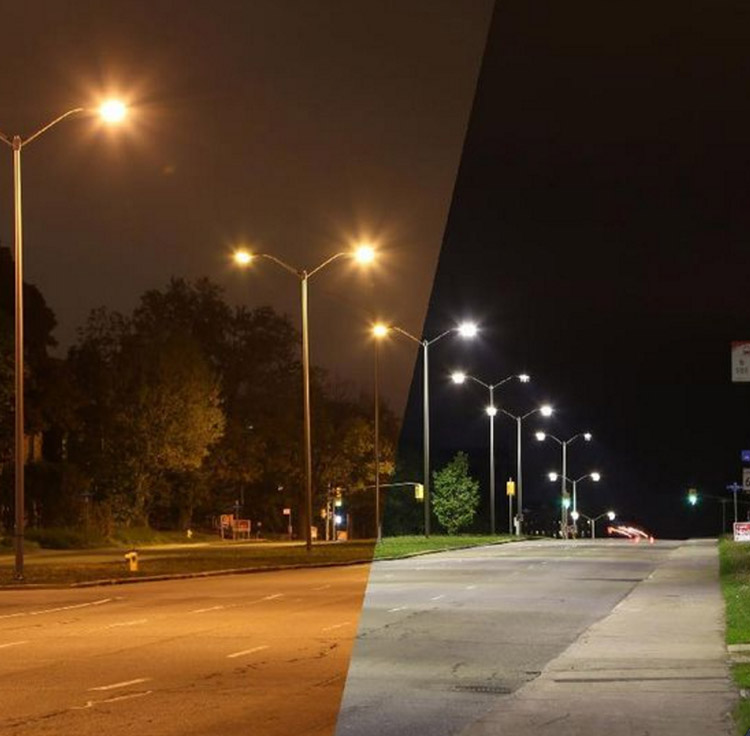
The “Sticker Price” of an intelligent light is a distraction. The only metric that matters to municipal CFOs is the Total Cost of Ownership (TCO).
1. The 75% Energy Reduction Formula
- Traditional HPS Light: 250W consumption.
- Standard LED Upgrade: 120W (50% reduction).
- Sinoco Intelligent LED: 60W + Smart Dimming (75-80% total reduction).By dropping to 30% power during the hours of 1 AM to 5 AM, the intelligent system pays for its own “Smart Premium” in less than 24 months through electricity savings alone.
2. Maintenance Revolution: Predictive vs. Reactive
In a “Dumb” lighting system, maintenance is reactive. A truck is sent out only after someone reports a dark street.
In a Sinoco Intelligent System, maintenance is predictive. The CMS monitors the “Lumen Depreciation” and the “Driver Temperature.” If a driver shows signs of failing, the system alerts the team before the light goes out. This eliminates “Scouting Missions” and reduces “Truck Roll” costs by up to 60% annually.
Global Regulatory Compliance: The Sinoco Guarantee
When partnering with a global intelligent LED street light manufacturer, compliance is a matter of legal safety. Our fixtures are engineered to exceed the most stringent international standards:
- CE & RoHS: Ensuring no hazardous materials (like mercury) are used and the product is safe for the European market.
- UL & DLC: Meeting the high safety and performance standards required for North American utility rebates.
- IP66 & IK10: Our fixtures are rated for “Dust Tight” and “Heavy Seas” (IP66), and can withstand 20 joules of impact (IK10), protecting your investment from vandalism and extreme storms.
- ASTM B117: We use AkzoNobel anti corrosion coatings that pass 1,000 hour salt spray tests, making our lights ideal for coastal highways.
The Role of Artificial Intelligence in Lighting: Predictive Maintenance Algorithms

As an intelligent LED street light manufacturer, we don’t just provide a dashboard; we provide AI driven insights. In 2026, the Sinoco CMS utilizes machine learning to predict failure before it happens.
How It Works
The smart controller inside every light captures millions of data points: voltage fluctuations, driver temperature, power factor (PF), and lumen output. Our AI algorithms analyze these patterns across the entire city.
- The “Early Warning” System: If a specific light shows a 5% increase in driver temperature compared to its neighbors, the AI flags it as a “Potential Failure.”
- The Optimization Engine: The AI can analyze traffic patterns (when integrated with cameras or PIR sensors) and automatically suggest more efficient dimming schedules. For example, if a major road has zero traffic between 2 AM and 4 AM on Tuesdays, the system suggests a deeper dim, saving an extra 10% in energy that a human manager might have missed.
Global Case Study Framework: Middle East vs. Europe
Urban lighting is not “One Size Fits All.” Different climates present different engineering challenges for an intelligent LED street light manufacturer.
1. The High Heat Challenge (Middle East / Australia)
In regions where ambient temperatures exceed 45°C, the challenge is keeping the smart node from “Cooking.”
- Solution: We use High Tg (Glass Transition Temperature) PCBs. Standard boards warp at high heat; ours remain stable up to 170°C. Combined with our ADC12 cooling, Sinoco intelligent lights are the preferred choice for Dubai, Riyadh, and Perth.
2. The Low Light / High Reflectivity Challenge (Northern Europe / Canada)
In snowy environments, the ground is highly reflective.
- Solution: Using the CMS, these cities can actually dim their lights to 40% even during peak hours when snow is on the ground, as the “Albedo Effect” provides natural brightness. This is a level of optimization only possible with an intelligent LED street light system.
Manufacturing Quality: From Solder Paste to PCB Assembly
A street light is only as “Intelligent” as the reliability of its circuit board. At Sinoco, we manage the entire manufacturing chain in house.
- Lead Free Reflow Soldering: We use automated SMT (Surface Mount Technology) lines with precise thermal profiling. This ensures every connection on the smart controller is vibration roof—a necessity for poles near heavy highway traffic.
- Conformal Coating: Every PCB in our intelligent fixtures is treated with a specialized moisture proof coating. This prevents “Dendrite Growth” (microscopic shorts) caused by the humidity in coastal or tropical cities.
- In Circuit Testing (ICT): Before a light leaves our factory, it undergoes a 24-hour “Burn In” test. We cycle the smart node on and off 1,000 times to ensure the wireless transceiver is 100% stable.
Interoperability: The TALQ Consortium Standards
One of the biggest fears for city planners is “Vendor Lock in”—buying a system that only works with one manufacturer’s software. As a global intelligent LED street light manufacturer, Sinoco is a strict adherent to the TALQ Consortium Standards.
What is TALQ?
TALQ is the global standard for smart city device interoperability. It ensures that a Sinoco light can talk to a software platform made by another company, or work alongside lights from a different manufacturer in the same city grid.
- Why it matters: It gives the municipality freedom. You can start with a small pilot program and grow your smart city grid over 20 years, mixing and matching technologies as they improve, knowing that the “Common Language” of TALQ keeps everything connected.
Integration with 5G and Future Smart City Tech
The street light pole is the most valuable real estate in a city. Because it is already powered and elevated, it is the perfect platform for 5G Small Cells.
Our intelligent lights are designed with “Power Over Ethernet” (PoE) capabilities and extra structural load bearing capacity. This allows municipalities to lease their light poles to telecom companies, turning a “Cost Center” (lighting) into a “Revenue Center” (telecom infrastructure).
FAQ: Solving Your Smart City Challenges
Q: How do I choose between LoRaWAN and Zigbee for my city?
A: If your city is spread out with hilly terrain, LoRaWAN is better due to its long range. If you have a dense downtown with thousands of lights close together, Zigbee’s mesh networking provides faster real time response for smart led street light installation.
Q: Can I manage the lights from my smartphone?
A: Yes. The Sinoco CMS is cloud based and mobile optimized. You can override schedules, dim specific zones, or check energy reports from any authorized device globally.
Q: Is the system secure against hackers?
A: We utilize AES-128 bit end to end encryption. This is the same grade used by financial institutions, ensuring that your city’s lighting grid cannot be tampered with by unauthorized parties.
Q: What is the lifespan of the smart controller?
A: Our controllers are designed to last 100,000 hours, matching the lifespan of the LED chips. We use high grade solid state capacitors that resist the heat cycling of outdoor environments.
Q: How does the system handle “Daylight Harvesting”?
A: Each light can be fitted with an intelligent photocell. This allows the light to dim gradually as the sun rises, rather than a hard “On/Off,” further extending the life of the driver and saving those final few watts of energy every morning.
Conclusion: Partner with Sinoco for a Connected Tomorrow
The era of static, wasteful urban lighting is over. Selecting an intelligent LED street light manufacturer is a commitment to the next quarter century of your city’s life. By choosing Sinoco, you aren’t just buying a fixture, you are adopting a philosophy of 200 LM/W efficiency, ADC12 durability, and Smart City connectivity.
We provide the hardware to see the road and the intelligence to manage the future.