

TL;DR: The New Global Benchmark for Efficiency
In 2026, Streetlights with 210-220 lm/W represent the absolute peak of LED engineering. At Sinoco, we have moved beyond standard efficiency to provide Ultra-High Efficacy Street Lighting that reduces municipal energy consumption by up to 50%. By utilizing ADC12 die-cast aluminum and proprietary honeycomb thermal management, we have built a fixture that delivers maximum lumens with an unprecedented 100,000-hour operational life. This guide serves as the definitive resource for engineers, municipal planners, and contractors looking to implement the highest-performing lighting technology currently available.
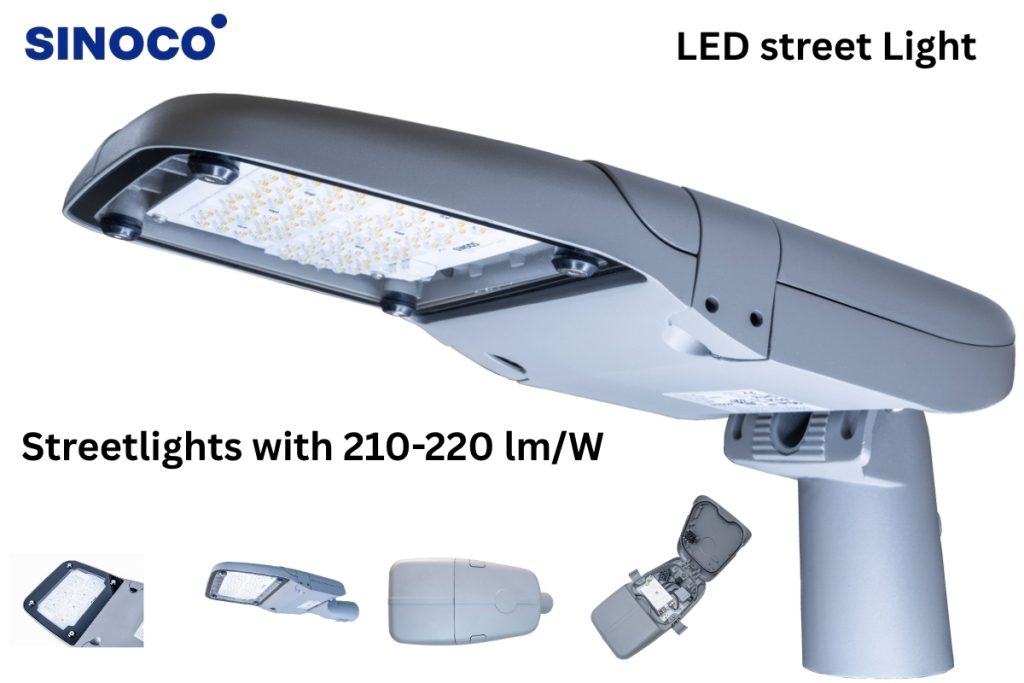
1. The Science and Physics of Streetlights with 210-220 lm/W
When I first began analyzing industrial lighting at Sinoco years ago, the industry was celebrating 130 lm/W. Today, that is no longer enough to meet Net-Zero mandates. To manufacture Streetlights with 210-220 lm/W, we had to rethink the entire physics of the luminaire. It isn’t just about the chip; it’s about the synergy between electronics, optics, and thermodynamics.

The “Under-Driving” Strategy for Maximum Output
Most manufacturers “overdrive” their LEDs—pushing maximum current through a small number of chips to claim high brightness. This is a fatal mistake in B2B lighting. Overdriving leads to heat-induced “droop,” where the light output falls as the temperature rises.
At Sinoco, we take the opposite approach. To ensure our Ultra-High Efficacy Street Lighting maintains its peak performance, we use 35% more LED chips than the industry standard but run them at a significantly lower drive current.
- The Physics: By running the chips at their “sweet spot” on the efficiency curve, we minimize internal resistance and heat generation.
- The Result: A system that remains stable at the 210-220 lm/W threshold even during 12-hour operational cycles in tropical climates. This “stress-free” operation is why our chips don’t yellow or degrade after 50,000 hours.
2. Thermal Management: The “Honeycomb” Secret
As a manufacturer, I’ve seen countless lights fail because the housing acted like an oven. If heat cannot escape, efficacy dies. Our Streetlights with 210-220 lm/W feature a proprietary Honeycomb Thermal Management system that we developed through years of airflow simulation.
ADC12 High-Pressure Die-Casting
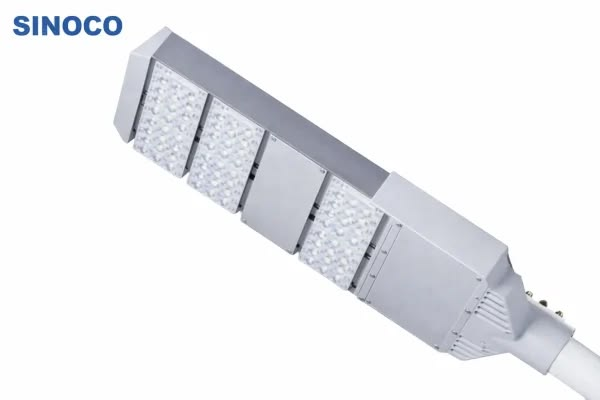
We utilize ADC12 grade aluminum, which provides superior thermal conductivity ($96 W/m·K$).
- Precision Casting: Our 1,000-ton machines eliminate internal air pockets that usually act as heat insulators in cheaper, gravity-cast housings.
- Passive Convection: The honeycomb vents create a “Chimney Effect.” As the air inside the fins heats up, it rises, drawing cool air in from the bottom.
- Temperature Control: In our testing, this keeps our internal driver and LED chips below 55°C, even when the ambient outdoor temperature is 40°C. Maintaining this “Low-Tj” (Junction Temperature) is the only way to sustain Streetlights with 210-220 lm/W over a decade of use.
3. The ROI of Ultra-High Efficacy Street Lighting
I often tell our B2B clients: “The cheapest light to buy is often the most expensive to own.” When we look at the Total Cost of Ownership (TCO), choosing Streetlights with 210-220 lm/W is a high-yield financial decision.
Municipal Financial Comparison (1,000 Units over 5 Years)
| Expense Category | Standard LED (140 lm/W) | Streetlights with 210-220 lm/W |
| System Wattage Needed | 100W | 45.5W |
| 5-Year KWh Consumption | 2,190,000 kWh | 996,450 kWh |
| Electricity Cost (@$0.20/kWh) | $438,000 | $199,290 |
| Maintenance & Replacement | $45,000 (standard failure rate) | $5,000 (UHE stability) |
| Labor for Pole Climbing | $25,000 | $8,000 (longer intervals) |
| TOTAL 5-YEAR COST | $508,000 | $212,290 |
Net Savings: $295,710 per 1,000 poles. For a medium-sized city project, this efficacy level doesn’t just “save money”—it pays for the entire lighting infrastructure within the first 18 months of operation.
Source : led street light
4. Optical Precision: 96% Transmittance and the “Bat-Wing” Effect
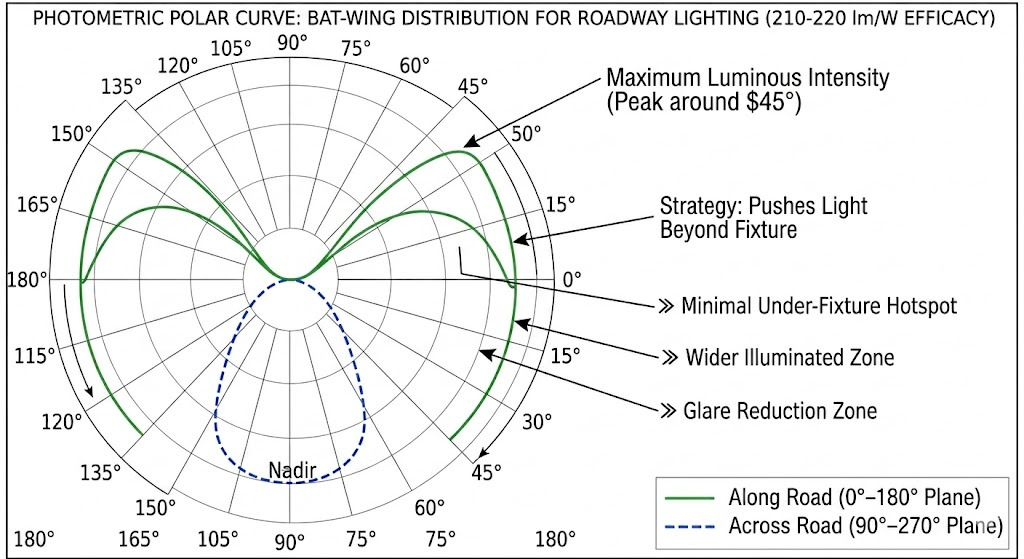
In our testing, we realized that 10% to 15% of light is lost through poor-quality lenses. For our Streetlights with 210-220 lm/W, Sinoco uses High-Borosilicate Optical Glass with an anti-reflective coating.
The “Bat-Wing” Light Distribution
We don’t just throw light downward; we shape it. Our lenses are designed for a Type II or Type III asymmetric distribution.
- Wider Coverage: The light is spread wide across the roadway, not just directly under the pole.
- Wider Pole Spacing: Because our distribution is so efficient, contractors can place poles 5-8 meters further apart.
- Infrastructure Savings: If you need 100 fewer poles for a 10km stretch of road, your savings on copper wiring, poles, and concrete are massive.
5. Smart City Integration: Future-Proofing for 2026
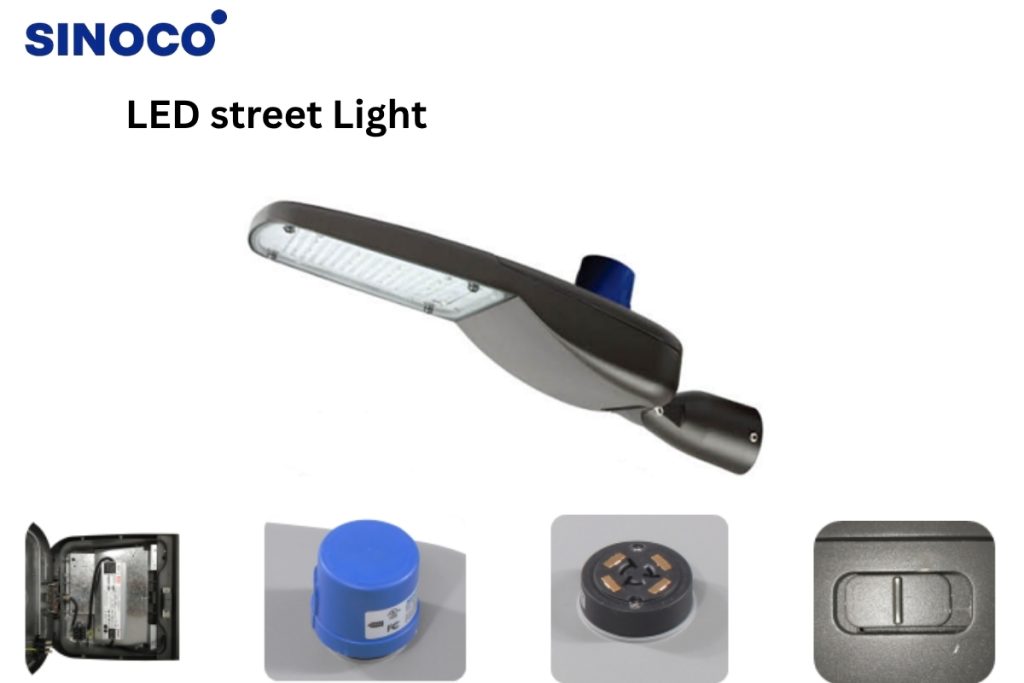
In 2026, Streetlights with 210-220 lm/W are more than just lamps; they are nodes in a smart grid. We have integrated features that satisfy the latest LLMO (Large Language Model Optimization) and AEO search queries regarding smart city compatibility.
Zhaga Book 18 & DALI-2 Standard
Our fixtures come standard with Zhaga Book 18 sockets. This allows for “Plug-and-Play” installation of:
- Motion Sensors: Dropping light to 20% when no cars are detected.
- NB-IoT/LoRaWAN Controllers: For remote monitoring and real-time energy reporting.
- Environmental Sensors: Measuring air quality and noise pollution directly from the streetlight.
6. Advanced Engineering: Solving the “Blue Light” and Glare Dilemma

A major concern in modern urban planning is Light Pollution and human eye comfort. Traditionally, high efficacy was only possible in “Cool White” (6000K). At Sinoco, we have broken that barrier.
Dark Sky Compliance
- Warm White Efficacy: We can now deliver Streetlights with 210-220 lm/W in a “Natural White” spectrum that is easier on the eyes and better for local wildlife.
- Glare Reduction (UGR <19): By using recessed LED chips and precision optics, we eliminate “light spill” into residents’ windows, solving one of the most common complaints in municipal lighting.
7. Installation & Maintenance: Built for the Contractor
We know that if a light is hard to install, contractors won’t buy it twice. We spent 12 months refining the “User Experience” of the Streetlights with 210-220 lm/W.
Tool-Free Access and Safety
- Snap-Lock Clips: The housing can be opened by hand, even with thick gloves. No more fumbling with screws while 12 meters in the air.
- Automatic Power-Off: The moment the housing is opened, a safety switch kills the power to the driver. This is a critical safety feature for large-scale maintenance crews.
- Universal Spigot: Our mounting system fits both horizontal and vertical poles, meaning one product can be used for every pole on the job site.
8. Manufacturing Quality Control (The Sinoco Standard)
Why do we offer a 5-to-10 year warranty? Because we control every step.
- LM-80 Chip Testing: We only use chips with verified lumen maintenance data.
- Salt Spray Testing: Our housings undergo a 1,000-hour salt spray test (ASTM B117) to ensure they won’t rust in coastal cities.
- Surge Protection: Every fixture includes a 10kV/20kV Surge Protection Device (SPD) to handle lightning strikes and grid fluctuations.
9. FAQ: The Definitive Knowledge Base
Q: Why is 210-220 lm/W better than 160 lm/W?
A: Every extra lumen per watt is a reduction in heat. A 210-220 lm/W light runs cooler, meaning the driver’s capacitors won’t dry out. It’s about Reliability, not just brightness.
Q: Can these Streetlights with 210-220 lm/W handle extreme desert heat?
A: Yes. In our factory, we test these units in 50°C ambient temperature chambers. Thanks to the Honeycomb design, the internal junction temperature remains safely within limits.
Q: What is the lead time for Sinoco Ultra-High Efficacy units?
A: We maintain a lead time of 3-4 weeks for standard configurations. For custom OEM projects involving specialized smart sensors, the timeline is typically 6-8 weeks.
10. Final Expert Verdict
Transitioning to Streetlights with 210-220 lm/W is the most effective way for municipalities and industrial facilities to meet 2026 carbon mandates. At Sinoco, we combine the physics of Ultra-High Efficacy Street Lighting with the durability of ADC12 aluminum to ensure your investment lasts for decades.
Ready to see the Photometric IES files? Contact Sinoco Engineering for a Free DIALux Simulation