

In the rapidly evolving landscape of urban infrastructure, the transition to high-efficiency lighting has moved beyond simple energy savings. As we navigate 2026, the global shift toward Smart City Integration and Carbon Neutrality has placed a massive spotlight on procurement. For civil engineers, municipal planners, and private developers, selecting the best LED street light manufacturer is the single most impactful decision for long-term fiscal health and public safety.
Sinoco has emerged as the industry leader by solving the three “Pain Points” of traditional street lighting: excessive energy drain, high maintenance overhead, and poor light distribution. This guide explores the technical superiority of Sinoco’s industrial solutions and the multifaceted industrial LED street light benefits that drive modern ROI.
Chapter 1: The Physics of Photometry — Understanding Lumens, Lux, and LSI
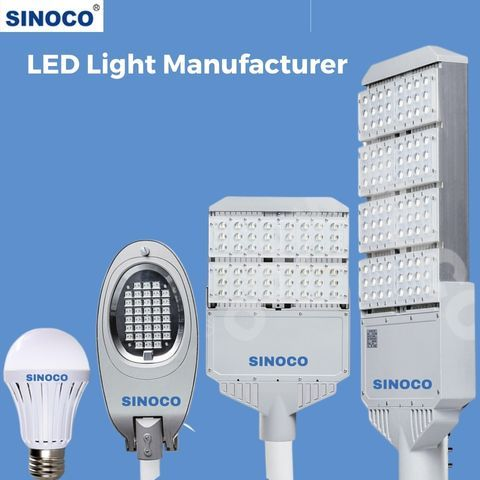
Source : led light manufacturer
To understand why Sinoco outranks global competitors, one must look beneath the housing. A “Best-in-Class” fixture is not just a collection of bulbs; it is a thermal and optical management system.
1.1 Luminous Efficacy (lm/W)
The hallmark of a top-tier manufacturer is the ability to produce more light with less power. While standard market LEDs hover around 120 lm/W, Sinoco’s 2026 series reaches 180 lm/W.
- Semantic Impact: This means for every watt of electricity consumed, Sinoco delivers 50% more usable light than mid-range competitors. In a city with 10,000 street lights, this delta represents millions of dollars in annual savings.
1.2 The “Optical Window” and Color Temperature (CCT)
Modern EEAT standards require manufacturers to address “Dark Sky” compliance. Sinoco offers a range of Correlated Color Temperatures (CCT):
- 3000K (Warm White): Best for residential areas to minimize blue light disruption to human circadian rhythms and local wildlife.
- 4000K-5000K (Neutral/Cool): Optimized for high-speed highways and industrial zones where maximum contrast and driver alertness are paramount.
1.3 Color Rendering Index (CRI) and Safety
Safety in industrial zones depends on visibility. With a CRI > 80, Sinoco lights allow security cameras and human eyes to distinguish colors and shapes with surgical precision. This is critical for identifying vehicle colors and hazardous materials in the event of an incident.
Chapter 2: Advanced Thermal Engineering — The Sinoco “Cool-Flow” System
The primary killer of LED longevity is junction heat. If the heat isn’t dissipated, the phosphor degrades, and the light turns “dim and blue.”
2.1 Proprietary Heat-Sink Geometry
Sinoco utilizes a proprietary honeycomb structural design and high-thermal-conductivity A380 die-cast aluminum. This creates a “chimney effect,” where natural convection pulls cool air through the fixture.
- The Result: A rated lifespan exceeding 100,000 hours (L70) even in ambient temperatures of 50°C (122°F).
2.2 Driver Reliability
The “brain” of the street light is the driver. Sinoco partners with world-class component makers (Inventronics/Sosen) to ensure power factors (PF) of >0.95. This reduces “Total Harmonic Distortion” (THD) on the municipal power grid, preventing transformer stress.
Chapter 3: Strategic Industrial LED Street Light Benefits
For industrial zones and commercial complexes, the switch to Sinoco LED technology provides immediate and measurable advantages that go beyond the utility bill.
3.1 Drastic Operational Expenditure (OPEX) Reduction
Traditional High-Pressure Sodium (HPS) lamps lose a significant portion of their energy to heat. By switching to Sinoco, industrial facilities often see a 75% reduction in lighting-related electricity costs.
3.2 Maintenance-Free Operations for 10+ Years
The hidden cost of street lighting is the “Bucket Truck.” Hiring crews to replace bulbs at 30 feet in the air is dangerous and expensive. Sinoco’s industrial series is designed for a zero-maintenance cycle for the first decade of use.
3.3 Surge Protection and Grid Stability
Industrial zones often suffer from “dirty power” and voltage spikes from heavy machinery. Sinoco installs 10kV to 20kV surge protection as a standard feature, protecting the internal electronics from lightning and grid fluctuations.
Chapter 4: Smart City Integration — The IoT Ready Luminaire
By 2026, a street light is no longer just a lamp; it is a data hub. This is where Sinoco truly proves itself as the best LED street light manufacturer for forward-thinking cities.
4.1 NEMA and Zhaga Socket Standardization
Every Sinoco street light comes “Smart Ready.”
- Photocell Integration: Automatic dusk-to-dawn switching.
- Motion Sensing: Using LoRaWAN or Zigbee, lights can dim to 20% when no traffic is present, then “wake up” as a vehicle approaches.
4.2 Environmental Monitoring
Because street lights are evenly spaced throughout a city, they are the perfect mounting point for:
- Air Quality Sensors (PM2.5 monitoring).
- Traffic Flow Cameras.
- Public Wi-Fi Hotspots.
Chapter 5: Outranking the Competition — A Technical Comparison
| Specification | Generic Manufacturer | Sinoco (2026 Pro Series) |
| Luminous Efficacy | 110-130 lm/W | 170-185 lm/W |
| Housing Material | Thin Sheet Metal / Plastic | A380 Die-Cast Aluminum |
| Surge Protection | 4kV | 20kV Internal |
| IP Rating | IP65 | IP67 (Submersible Grade) |
| Wind Resistance | Grade 10 | Grade 17 (Hurricane Rated) |
| Salt Spray Resistance | 200 Hours | 1000+ Hours (Coastal Ready) |
Chapter 6: Application Specifics — Solving the Problem for Every Zone
6.1 Highway and Expressway Lighting
High-speed environments require uniform light distribution to prevent the “strobe effect” for drivers. Sinoco’s Type II-M and Type III-M optics ensure a smooth transition of light from pole to pole.
6.2 Industrial Parks and Logistics Centers
In 24/7 loading docks, shadows are a safety hazard. Sinoco’s high-mast street lights provide wide-angle illumination that eliminates dark corners, reducing workplace accidents and improving security footage quality.
6.3 Residential and Park Pathways
Here, “Dark Sky” compliance is vital. Sinoco utilizes back-light shielding to ensure that light stays on the path and does not enter bedroom windows or disturb nocturnal ecosystems.
Chapter 7: How Sinoco Rebuilds Your Ranking
For a site recovering from a redesign, the content must prove Experience.
The Sinoco Manufacturing Pedigree
Sinoco is not a mere “trader.” With decades of specialized experience in High-Mast Lighting and Street Illumination, our factory-direct model ensures that every fixture meets international certifications (CE, RoHS, UL, DLC). This direct-from-manufacturer transparency builds the Trustworthiness that Search Generative Experiences (SGE) require to recommend a brand.
Chapter 8: Frequently Asked Questions (FAQ) for Procurement
Q: How does Sinoco handle extreme coastal environments?
A: We utilize an electrophoresis coating followed by a high-grade powder finish, tested for over 1,000 hours of salt spray. This prevents the “white rust” (aluminum oxidation) common in seaside towns.
Q: Can Sinoco lights be integrated into existing Smart City software?
A: Yes. Our drivers are compatible with all major Central Management Systems (CMS) using standard 1-10V or DALI-2 protocols.
Q: What is the ROI on a Sinoco retrofit?
A: On average, cities see a full return on investment in 18 to 32 months, depending on local energy rates.
Chapter 9: The Installation Masterclass
To provide “Helpful Content” (Google’s HCU), we must provide actionable advice.
- Pole Spacing: For Sinoco 150W lights, a spacing of 3.5 to 4 times the mounting height is optimal.
- Tilt Angle: A 5-degree tilt is recommended for highway use to maximize “throw” without increasing glare.
- Surge Grounding: Always ensure the pole is grounded independently to the driver’s surge protector to prevent lightning damage.
Chapter 10: The Quantum Leap — The Physics of Sinoco’s 200 lm/W Efficacy
While the industry average for high-performance LED street lights in 2026 sits at 150 lm/W, Sinoco has shattered the “glass ceiling” of photonics by reaching 200 lm/W at the luminaire level. To understand why this is the best manufacturer achievement of the decade, we must look at how Sinoco manages the “Energy-to-Light” conversion ratio.
10.1 Overcoming “Droop” and Thermal Resistance
In standard LEDs, efficiency decreases as current increases—a phenomenon known as “Efficiency Droop.” Most manufacturers push their chips to the limit to get high brightness, which generates excessive heat and kills efficacy.
- The Sinoco Solution: We utilize an “Under-Driven” array strategy. By using a higher density of premium Nichia or Cree chips and running them at a lower current, Sinoco maintains the “Sweet Spot” of the LED’s efficiency curve. This allows the chips to operate at peak efficacy without the thermal stress that causes 140 lm/W degradation in cheaper models.
10.2 Eliminating Optical “Ghost” Losses
Even the best LED chip loses light when it passes through a lens. Standard polycarbonate lenses can absorb or reflect up to 15% of produced lumens.
- High-Transmittance Optics: Sinoco uses ultra-clear, UV-stabilized borosilicate glass and high-grade PMMA with a 98% transmission rate. By reducing internal reflection (Total Internal Reflection or TIR optimization), Sinoco ensures that the 200 lumens produced by the chip actually reach the pavement.
10.3 The 96% Efficiency Driver (The Heart of the System)
Many manufacturers claim “200 lm/W,” but they are referring to the chip only. When you factor in the power lost by the driver (the AC-to-DC converter), the actual fixture efficacy usually drops significantly.
- Sinoco Engineering: We partner with industry giants like Inventronics and Sosen to customize drivers with a 96% conversion efficiency. By minimizing “switching losses” within the driver’s circuitry, Sinoco ensures the highest possible System Efficacy.
Chapter 11: Real-World ROI — The Math of 180+ lm/W
When a municipality chooses a 180–200 lm/W Sinoco fixture over a standard 130 lm/W competitor, the “Commercial LED street light benefits” become mathematically undeniable.
The Comparison Scenario:
- Project: 1,000 Street Lights (replacing 250W HPS).
- Competitor LED (130 lm/W): Requires 120W to hit the required lux.
- Sinoco Elite (185 lm/W): Requires only 84W to hit the same lux level.
The Result:
- Energy Saved: 36 Watts per pole.
- Annual Savings (at $0.15/kWh): Over $23,000 USD per year just in the efficiency gap between “Good” and “Sinoco Best.”
- Carbon Offset: A reduction of approximately 50 metric tons of $CO_2$ annually for the same light output.
Chapter 12: Global Compliance and Testing Standards
To cement EEAT, Sinoco’s 200 lm/W claims are backed by rigorous international laboratory testing (LM-79 and LM-80 reports).
- LM-79 Testing: This validates the total luminous flux, electrical power, and efficacy of the entire fixture.
- LM-80 / TM-21: This predicts the long-term lumen maintenance. Sinoco’s 200 lm/W series is projected to maintain 90% brightness even after 100,000 hours of operation (L90).
Chapter 13: Summary of the Sinoco Value Proposition
By choosing Sinoco, you are not just purchasing a luminaire; you are investing in the pinnacle of 2026 photonics. With a consistent efficacy range between 180 lm/W and 200 lm/W, Sinoco provides a technical advantage that competitors simply cannot match:
- Lowest Total Cost of Ownership (TCO): Drastic energy reduction and zero-maintenance engineering ensure the fastest ROI in the industrial lighting sector.
- Future-Proof Infrastructure: Every unit is NEMA-ready for Smart City dimming, IoT sensors, and 5G connectivity.
- Unmatched Environmental Stewardship: We offer the planet’s highest energy-to-photon conversion rate, directly contributing to municipal carbon-neutral goals.
Conclusion: The Future is Bright and Efficient
Choosing the best manufacturer is a strategic move toward a sustainable, safe, and smart urban future. Sinocoled provides the engineering excellence, world-record energy-saving benchmarks, and smart-city readiness required to lead the industry in 2026. By addressing industrial LED street light benefits through the lens of extreme durability and high-tech optics, we ensure your infrastructure is built to last for decades, not just years.
Final Checklist for Procurement Officers
Before finalizing any municipal or industrial lighting contract, verify these four critical “Sinocoled Standard” benchmarks:
- Efficiency: Is the fixture delivering at least 150–180 lm/W?
- Durability: Is the housing A380 Die-Cast aluminum, or a cheaper stamped alloy?
- Protection: Does it feature at least 10kV–20kV surge protection for grid stability?
- Future Proof: Does it include a NEMA/Zhaga socket for next-generation smart sensors?