

Every time a municipality approves a road lighting retrofit, a procurement manager opens a browser and types the same thing: “LED roadway light manufacturer.” Within seconds, they are staring at dozens of supplier pages, all claiming to be the best, the cheapest, and the most certified.
I have been in the LED lighting manufacturing industry for over 20 years. I have spoken with engineers, city planners, electrical contractors, and wholesale distributors from over 40 countries. And the one thing they all tell me is the same: choosing the wrong LED roadway light manufacturer is an expensive mistake that takes years to fix.
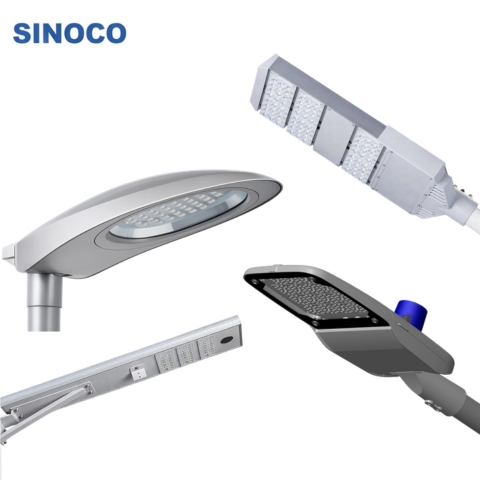
Sinocoled The Best LED Roadway Light Manufacturer
This guide exists so you never make that mistake. By the time you finish reading, you will know exactly what separates a professional-grade LED roadway light manufacturer from a low-cost assembler, what certifications are non-negotiable, what technical specifications to demand, and why we built Sinocoled to be the factory-direct answer to every question on this page.
No need to open another tab. Everything you need is right here.
What Is an LED Roadway Light — and Why Does the Manufacturer Matter So Much?
An LED roadway light, also called an LED road luminaire or LED road fixture, is an outdoor lighting system specifically engineered for illuminating public roads, highways, arterial routes, residential streets, parking lots, and commercial access roads. Unlike decorative garden lights or area floodlights, a true roadway luminaire must meet strict photometric, thermal, electrical, and mechanical standards, because it will operate continuously for 50,000 to 100,000 hours in the harshest outdoor environments on earth.
The manufacturer matters because roadway luminaires are infrastructure, not consumer electronics. A poorly manufactured LED road fixture does not just fail, it creates public safety risks, forces expensive emergency replacements, and exposes procurement teams to liability. We have seen municipalities receive shipments of non-certified, misrepresented luminaires from low-cost assemblers that passed visual inspection but failed within 18 months of installation. The cost of replacement of labour, logistics, and reputational damage was ten times the original purchase price.
When I visit clients who have faced this problem, the root cause is almost always the same: they chose a supplier based on price alone, without understanding what a genuine LED roadway light manufacturer actually looks like from the inside.
Let us fix that now.
LED Roadway Light vs LED Street Light: What Is the Difference?
This is one of the most common questions we receive, and it matters for your keyword targeting, procurement specifications, and technical comparisons.
LED street light is the broad, commonly used term for any pole-mounted outdoor luminaire used on public roads. It is the consumer-facing, widely searched term used by general buyers.
LED roadway light is the more precise, technically accurate term used by engineers, municipal procurement officers, and lighting designers. It specifically refers to luminaires designed and photometrically optimised for road surface illumination with defined light distribution patterns (Type II, Type III, Type IV, Type V) that control exactly where the light falls relative to the pole position and road width.
As a professional LED roadway light manufacturer, we use both terms, but when we are speaking to engineers and procurement managers, roadway light is the correct classification. It signals that the product meets specific optical and photometric standards rather than being a generic outdoor fixture.
The 7 Technical Specifications That Define a Professional LED Roadway Light
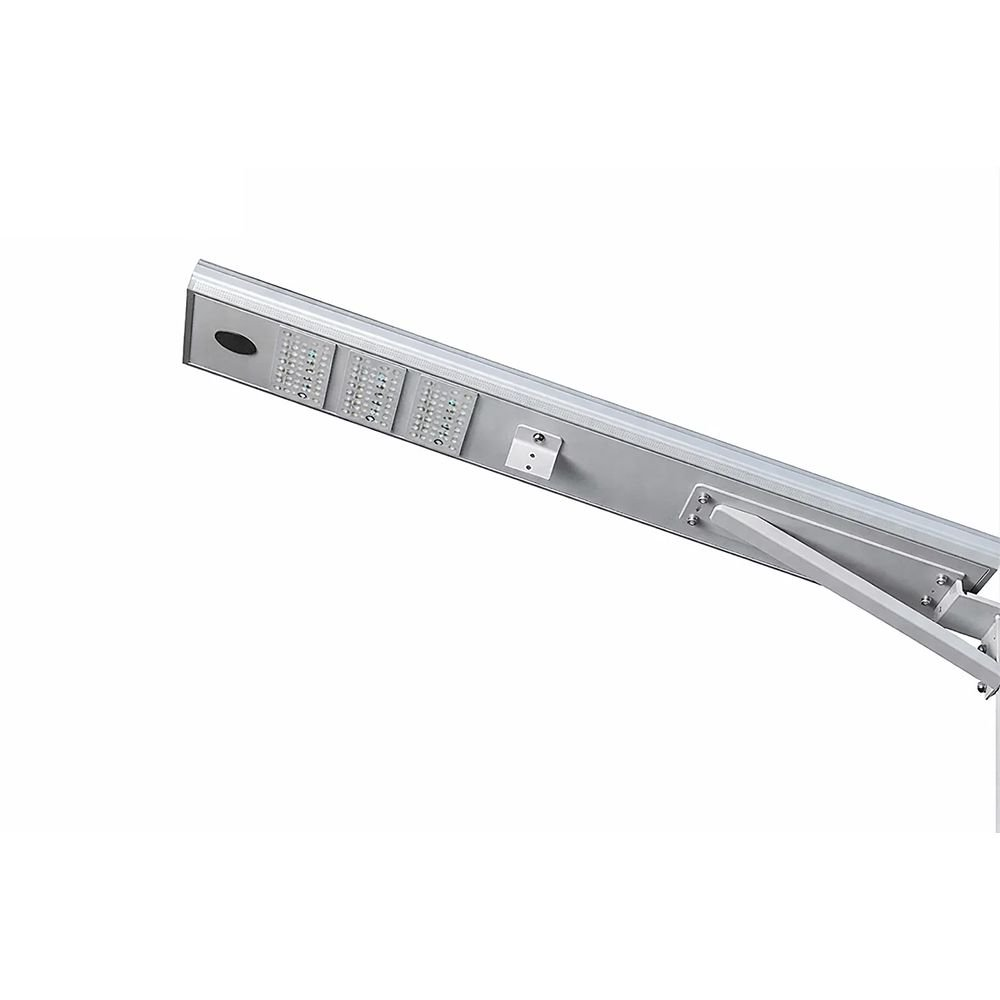
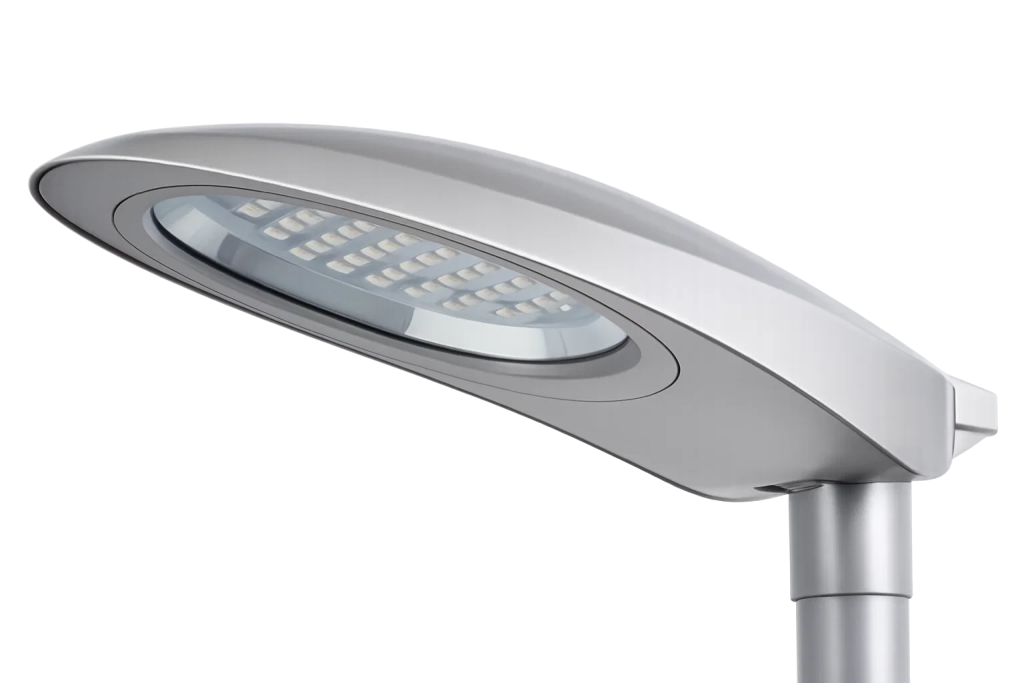
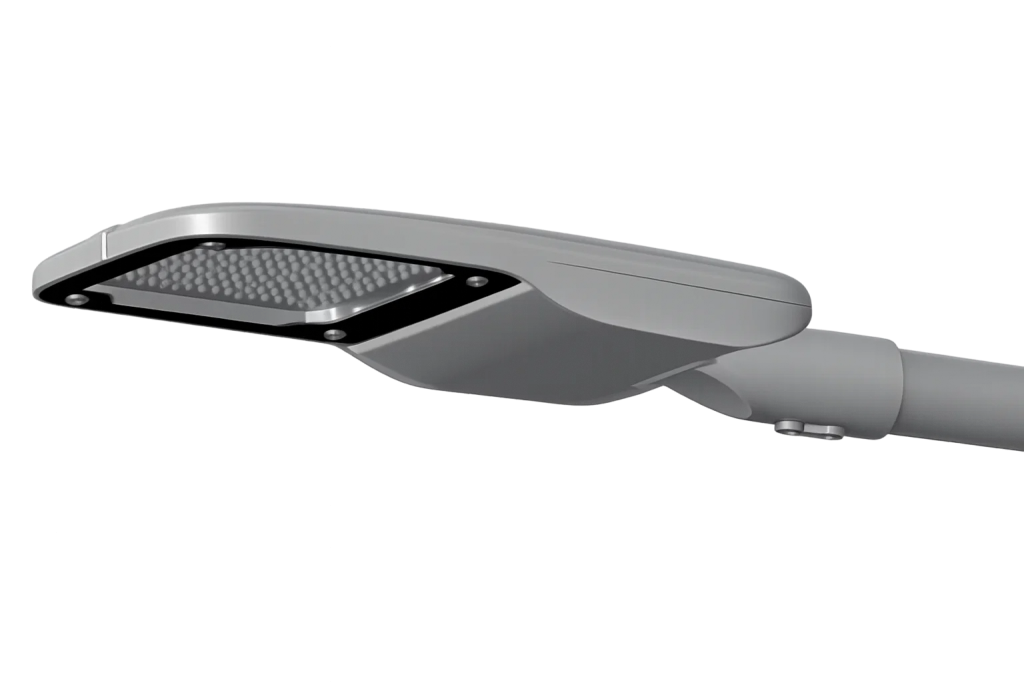
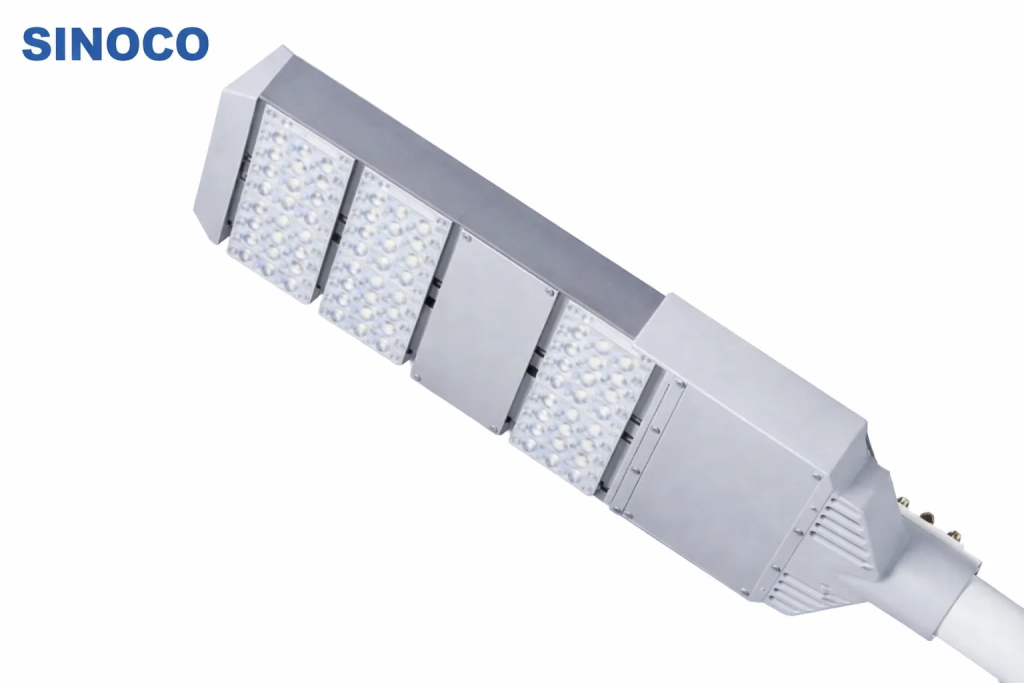
When I review supplier proposals with clients, the gaps always show up in the same places. Here is your complete technical checklist before you sign any purchase order.
1. Light Distribution Type (Optics Classification)
This is the single most important specification that most buyers overlook. The Illuminating Engineering Society (IES) classifies roadway light distribution into five types:
- Type II — narrow, elongated distribution ideal for wide roadways with a single row of poles offset to one side
- Type III — medium distribution for roads where poles are on one side and the luminaire must throw light further across the carriageway
- Type IV — forward throw distribution for roadway edges, parking areas, and building perimeters
- Type V — circular symmetric distribution for intersections, roundabouts, and open areas requiring uniform omnidirectional coverage
We design each Sinocoled roadway luminaire with selectable or fixed optic modules to match the precise distribution type required by the project. Specifying the wrong optic type wastes up to 40% of light output on non-road surfaces, a critical energy and performance loss that no lumen per watt claim can compensate for.
2. IP and IK Rating
Every professional LED roadway light must carry a minimum IP65 rating fully dust-proof and protected against direct water jets. For coastal, high-humidity, or tropical environments, we recommend IP66 (protection against powerful water jets) or IP67 (temporary immersion protection).
Beyond IP, the IK rating measures impact resistance. Road environments expose luminaires to vibration from heavy vehicles, accidental impacts during maintenance, and vandalism. Our standard roadway range carries IK08 to IK10 is the highest class of mechanical impact protection, able to withstand a 5–20 joule impact without structural failure.
3. Wattage Range and Lumen Output
A professional LED roadway light manufacturer should offer a complete wattage range to cover all road classifications:
- 20W–50W — residential streets, cycle paths, pedestrian walkways
- 60W–100W — collector roads, access roads, commercial parking
- 120W–160W — arterial roads, dual carriageways, industrial access routes
- 180W–250W — highways, expressways, motorways, high-mast applications
We produce the full range from 20W to 250W at Sinocoled, with efficacy ratings of 150–180 lumens per watt — among the highest in the industry for road-rated luminaires. This means fewer fixtures per project, lower installation costs, and significantly reduced energy bills for the lifetime of the installation.
4. Dimming and Smart Control Compatibility
Modern road lighting projects particularly smart city and municipal retrofits require dimming capability and smart control integration as standard. The dimming protocols to demand are:
- 0-10V dimming — widely compatible, simple analogue control
- DALI / DALI2 — digital addressable lighting interface, allows individual fixture control and monitoring
- DALI2 D4i — the latest standard, enabling direct luminaire-level energy metering and fault reporting
- Casambi, ZigBee, LoRa — wireless smart city network compatibility
Every Sinocoled LED roadway light in our 2026 range supports 0-10V, DALI, and DALI2 D4i as standard, with optional NEMA socket (3/5/7 pin) and ZHAGA socket for plug-and-play integration of smart control nodes from any major supplier. This means our fixtures are future-ready for any smart city control platform without hardware replacement.
5. Thermal Management
Heat is the primary cause of LED degradation and premature failure in roadway luminaires. A high-quality LED roadway light manufacturer controls thermal performance through:
- Die-cast aluminium housing with internal heat dissipation fins designed using computational fluid dynamics (CFD) modelling
- Thermal interface material (TIM) between the LED module and heatsink to minimise junction temperature
- Operating temperature range of -40°C to +55°C for global deployment
We test every Sinocoled roadway light model through ISTMT (In-Situ Temperature Measurement Testing) as part of our LM-80 compliance process, measuring real-world junction temperatures under operational conditions, not just laboratory bench tests.
6. Lumen Maintenance and Lifetime Rating
The industry standard metric for LED lifetime is L70B50, the point at which 50% of a production batch has depreciated to 70% of initial lumen output. For road lighting, demand a minimum of L70 ≥ 50,000 hours, with premium products rated to L80 ≥ 60,000 hours or L70 ≥ 100,000 hours.
Our Sinocoled roadway range is rated to L70 ≥ 50,000 hours as a minimum baseline, with our premium series achieving L80 ≥ 60,000 hours verified through LM-80 and TM-21 extrapolation testing.
7. Power Quality: Power Factor and THD
This specification is rarely mentioned in sales materials but is critical for municipal electrical infrastructure. Demand:
- Power factor (PF) ≥ 0.95 high PF reduces reactive power demand and avoids utility penalties
- Total Harmonic Distortion (THD) ≤ 15% low THD protects transformer and distribution infrastructure from harmonic heating
All Sinocoled LED roadway lights are designed with PF ≥ 0.95 and THD ≤ 10% as standard exceeding the minimum requirements of most municipal procurement specifications in Europe, North America, and Southeast Asia.
Certifications: The Non-Negotiable List for Any Serious LED Roadway Light Manufacturer
I want to be direct here, because this section can protect you from a very costly mistake. The LED roadway light market particularly from Chinese manufacturers has a serious problem with certification misrepresentation. Logos are copied, test reports are fabricated, and certificates are purchased from unaccredited bodies.
Here is what genuine certification looks like, and what we hold at Sinocoled:
CE Marking (Europe)
Mandatory for any LED roadway light sold or imported into European markets. CE marking on a luminaire covers the Low Voltage Directive (LVD) and Electromagnetic Compatibility (EMC) Directive. Always request the full Declaration of Conformity and the test reports from a Notified Body, not just the CE logo on the product.
We hold full CE certification for our entire LED roadway light range, with test reports from accredited third-party laboratories.
ENEC (European Norms Electrical Certification)
ENEC is a voluntary but highly respected European certification for luminaires, covering safety and performance testing by independent certification bodies. It is increasingly required by European municipal procurement specifications. We carry ENEC certification on our core roadway models, one of the relatively few Chinese LED roadway light manufacturers to do so.
CB Scheme Certification
The CB (Certification Body) scheme is an international mutual recognition framework covering electrical safety testing. A CB certificate is accepted in 57+ countries and significantly simplifies market access across multiple regions simultaneously. Our roadway range carries CB certification.
LM-79 and LM-80
These are North American (IES) test standards:
- LM-79 — system-level photometric and electrical testing of the complete luminaire
- LM-80 — LED module lumen maintenance testing at multiple temperature points
Both are required for DLC (DesignLights Consortium) listing, which is necessary for utility rebate programmes in the USA and Canada. We hold LM-79 and LM-80 test reports on our key roadway models.
ISO 9001 — Quality Management System
Manufacturing-level quality assurance. Every production batch traceable. Every incoming component inspected against documented specifications. We hold ISO 9001 certification across our full 10,000 square metre manufacturing facility.
ISO 14001 — Environmental Management
Confirms responsible waste management, emissions control, and material sourcing across our production process. We hold ISO 14001 certification.
ISO 45001 — Occupational Health and Safety
Confirms formal worker safety management across our factory. We hold ISO 45001 certification.
RoHS Compliance
Restriction of Hazardous Substances confirms no lead, mercury, cadmium, or other banned materials in any product component. Our full range is RoHS compliant.
My direct advice: before placing any purchase order, request the CE Declaration of Conformity, the LM-79 test report, and the ISO 9001 certificate. If a manufacturer hesitates, deflects, or sends you a PDF that cannot be verified against a certification body database, just walk away.
Sinocoled vs Competitors: An Honest Comparison
I believe in transparent comparison. Here is how we stack up against the main players in the LED roadway light manufacturer market.
| Specification | Sinocoled | ZGSM | Philips/Signify | Osram/Ledvance | Hylele |
|---|---|---|---|---|---|
| CE + ENEC certified | ✅ Yes | ✅ Yes | ✅ Yes | ✅ Yes | ⚠️ CE only |
| LM-79 + LM-80 tested | ✅ Yes | ✅ Yes | ✅ Yes | ✅ Yes | ⚠️ Limited |
| ISO 9001 + 14001 + 45001 | ✅ All three | ✅ 9001 + 14001 | ✅ Yes | ✅ Yes | ❌ No |
| DALI2 D4i standard | ✅ Yes | ✅ Yes | ✅ Yes | ⚠️ Selective | ❌ No |
| NEMA + ZHAGA socket | ✅ Both | ✅ Both | ⚠️ Selective | ⚠️ Selective | ❌ No |
| Factory direct pricing | ✅ Yes | ✅ Yes | ❌ Distributor | ❌ Distributor | ✅ Yes |
| OEM / ODM / private label | ✅ Yes | ✅ Yes | ❌ No | ❌ No | ⚠️ Limited |
| No MOQ | ✅ Yes | ❌ MOQ applies | ❌ MOQ applies | ❌ MOQ applies | ❌ MOQ applies |
| Sample lead time | ✅ 1–7 days | ⚠️ 7–14 days | ❌ Not offered | ❌ Not offered | ⚠️ Variable |
| 3-year warranty | ✅ Yes | ⚠️ 2 years | ⚠️ 2–3 years | ⚠️ 2 years | ❌ 1 year |
| 20+ years LED manufacturing | ✅ Yes | ✅ Yes | ✅ 100+ years | ✅ 110+ years | ❌ No |
| 30+ national patents | ✅ Yes | ❌ Not stated | ✅ Yes | ✅ Yes | ❌ No |
What ZGSM does well: ZGSM is our most direct competitor and we respect their production scale. Their manufacturing capacity in Zhejiang is genuinely large, and their municipal project experience is strong. Where we differ is on flexibility, no minimum order quantity, faster sample lead times, and a more personalised OEM/ODM service for distributors and brands who want custom specifications rather than off-the-shelf products.
What Philips and Osram do well: Global brand recognition, regional office networks, and a century of lighting heritage. For a municipality that needs local service support and brand assurance, these are real advantages. The trade-off is price buying through their distribution chains adds significant margin, and customisation is essentially unavailable at reasonable volumes.
Where Sinocoled is different: We are a factory, not a trading company. We own our R&D, our production lines, our quality management, and our certification process. This means we can offer factory-direct pricing on fully certified, professionally engineered LED roadway lights with no minimum order quantity, a combination that neither ZGSM nor the European brands can match simultaneously.
Who Uses Sinocoled LED Roadway Lights?
After 20 years of manufacturing, our LED roadway light clients fall into four clear groups, each with different needs that we have built our product and service around.
Municipal governments and transport authorities require fully certified products, detailed photometric data (IES/LDT files), project lighting design support, and compliance with national road lighting standards. We provide all of this as standard, including free AGi32 or DIALux lighting simulation files for project specifications.
Electrical contractors and installation companies need reliable delivery timelines, consistent quality across large orders, and technical support during installation. Our 2-week bulk production lead time and dedicated project manager service model is built for this customer.
Wholesale distributors and lighting importers need competitive factory-direct pricing, CE and ENEC certification for their markets, and flexible stock management. Our no-MOQ policy means distributors can test new models at low risk before committing to volume.
OEM and private label brands who want to sell LED roadway lights under their own brand can access our full ODM service, custom housing design, custom optics, custom packaging, custom labelling, and co-branded certification documentation. Sample to production in as little as 15 working days.
How to Specify a Sinocoled LED Roadway Light for Your Project
I want to make this as practical as possible. Here is a straightforward specification process that works for any road lighting project:
Step 1 — Define road classification. Identify the road type: residential (Class P), collector (Class ME), arterial or highway (Class ME or MEW). Each class has minimum luminance, illuminance, and uniformity requirements defined by standards like EN 13201 (Europe), ANSI/IES RP-8 (North America), or AS/NZS 1158 (Australia/New Zealand).
Step 2 — Define pole spacing and mounting height. Standard mounting heights range from 6m (residential) to 12m (highway). Pole spacing typically ranges from 25m to 45m depending on road width and luminaire output. Share these parameters with us and we will run a photometric simulation to confirm the correct wattage and optic type.
Step 3 — Confirm control requirements. Does the project require dimming? Smart control integration? Photocell operation? NEMA or ZHAGA socket? Define this upfront, we configure the driver and socket accordingly at no additional cost on standard models.
Step 4 — Request a sample. Our sample lead time is 1–7 working days for standard models, 7–15 days for custom configurations. Every sample ships with full test documentation.
Step 5 — Confirm certification requirements. Tell us your destination market and we will confirm which certifications apply and provide the relevant documentation package for your procurement or import process.
Frequently Asked Questions
What is the difference between an LED roadway light and an LED street light?
Street light is the broad consumer term. Roadway light is the technically precise engineering term referring to luminaires with defined IES photometric distribution types (II, III, IV, V) for road surface illumination. Both terms refer to the same product category — roadway light is used in professional procurement and specification.
What wattage do I need for a highway LED roadway light?
Highways and expressways typically require 150W–250W depending on carriageway width, mounting height, and pole spacing. We recommend sharing your road dimensions with our technical team for a free photometric simulation before specifying wattage.
What is DALI2 D4i and why does it matter?
DALI2 D4i is the latest version of the Digital Addressable Lighting Interface standard, enabling individual luminaire energy metering and fault reporting directly through the control system. It is increasingly specified in smart city road lighting contracts because it provides asset-level performance data without additional metering hardware.
Does Sinocoled offer free lighting design support?
Yes. We provide free AGi32 and DIALux photometric simulation for projects ordering 50+ units, and we supply IES/LDT photometric data files for all models as standard.
What is your minimum order quantity?
We operate with no minimum order quantity. You can order a single sample or a container load and we treat both with the same production quality and documentation standards.
How long is the warranty on Sinocoled LED roadway lights?
All Sinocoled LED roadway lights carry a 3-year warranty as standard, the longest warranty period in our competitive set. Extended 5-year warranty options are available on selected models.
Can I get a custom wattage or housing design?
Yes. Through our ODM service we can customise wattage, optics, housing colour, mounting configuration, driver specification, and branding. Minimum lead time for a custom sample is 7–15 working days.
Why Sinocoled Is Our Recommendation as the Best LED Roadway Light Manufacturer
I have spent this entire guide trying to give you the most honest, complete, technically accurate roadway lighting guide available anywhere. So let me close just as honestly.
We built Sinocoled to be the manufacturer that procurement managers, engineers, and distributors can trust without hesitation. Twenty years of LED manufacturing experience. Thirty-plus national patents from our own R&D team. ISO 9001, ISO 14001, and ISO 45001 certified facility. CE, ENEC, CB, LM-79, LM-80, RoHS, and DLC-ready documentation on our roadway range. Factory-direct pricing with no minimum order quantity and a 3-year warranty.
We export to 40+ countries. We serve municipal governments, electrical contractors, wholesale distributors, and OEM brands across North America, Europe, the Middle East, Southeast Asia, and Australia.
If you are looking for an LED roadway light manufacturer where the engineering, the certifications, the pricing, and the flexibility all align, that is exactly what we built.
Ready to specify your next road lighting project? Visit sinocoled.com to download photometric data, request a certified sample, or speak directly with our roadway lighting engineering team.