

One of the most common mistakes I see in LED street light procurement — and I have reviewed hundreds of municipal and commercial lighting projects across 40+ countries — is specifying wattage based on gut feel rather than road geometry and lighting standards.
A procurement manager sees a 100W LED street light and assumes it is twice as good as a 50W one. An electrical contractor picks 150W because the previous metal halide fitting was 250W and they want to make sure it is “bright enough.” A city engineer specifies 200W across the entire network because the project budget allows for it.
Every one of these decisions wastes money, wastes energy, and frequently produces a road that is either dangerously under-lit or so over-lit that it creates glare, light pollution, and complaints from residents within weeks of commissioning.
LED Street Light Wattage Guide: How to choose for Every Road type
This guide fixes that. By the time you finish reading, you will know exactly how to calculate the right wattage for every road classification, what the 2026 standards say about minimum and maximum illuminance levels, which Sinocoled product covers each application, and how to specify confidently without needing a lighting engineer for every project.
No need to open another tab. Every answer is right here.
Why Wattage Alone Is the Wrong Way to Specify an LED Street Light
Before we get into numbers, I want to address the most important concept in this entire guide — because getting this right changes every decision that follows.
Wattage does not equal brightness. Lumens equal brightness.
A 100W LED street light from a quality manufacturer like Sinocoled delivers 150–180 lumens per watt — meaning 15,000 to 18,000 lumens of light output. A 100W LED street light from a low-quality assembler using inferior LED chips and a poorly designed driver might deliver 90–110 lumens per watt — meaning only 9,000 to 11,000 lumens.
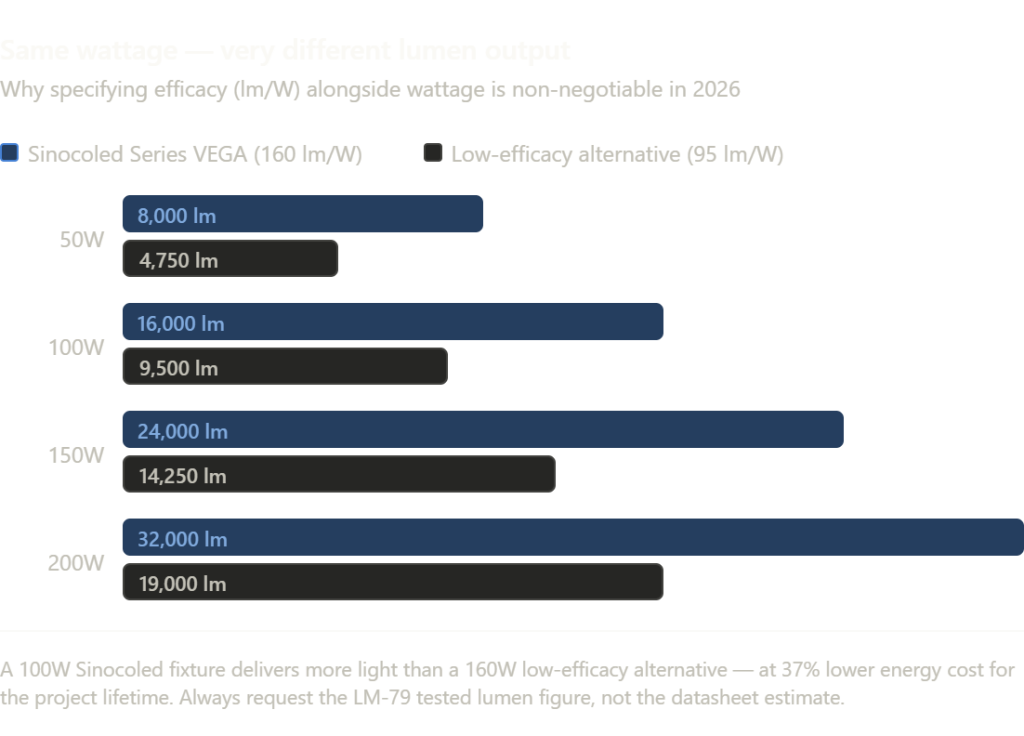
Both are “100W.” One delivers up to twice the useful light of the other.
This means that specifying by wattage without also specifying minimum luminous efficacy — lumens per watt — is the single biggest procurement mistake in the LED street lighting category. It is the reason a city can install 1,000 new LED street lights and find that half of them are dimmer than the sodium vapour lamps they replaced.
At Sinocoled, we design our 2026 street light range to deliver a minimum of 150 lumens per watt across all wattage configurations — and our premium Series VEGA models reach 180 lm/W. When you see a wattage figure in this guide, it is always accompanied by the lumen output at our guaranteed efficacy rating.
With that foundation established, let us get into the wattage selection framework.
The Road Classification Framework: How Road Type Drives Wattage Selection
The correct wattage for any LED street light installation is determined by four variables working together:
1. Road classification — what type of road is being lit and what lighting standard applies 2. Mounting height — the pole height above road surface 3. Pole spacing — the distance between consecutive poles 4. Road width — the total carriageway width including any footpaths
These four variables feed into a lumen calculation that determines the minimum light output required from each luminaire — and from that lumen figure, you derive the wattage at your chosen efficacy level.
The formula is straightforward:
Required lumens per luminaire = (Road area per pole × Target illuminance in lux) ÷ Utilisation factor
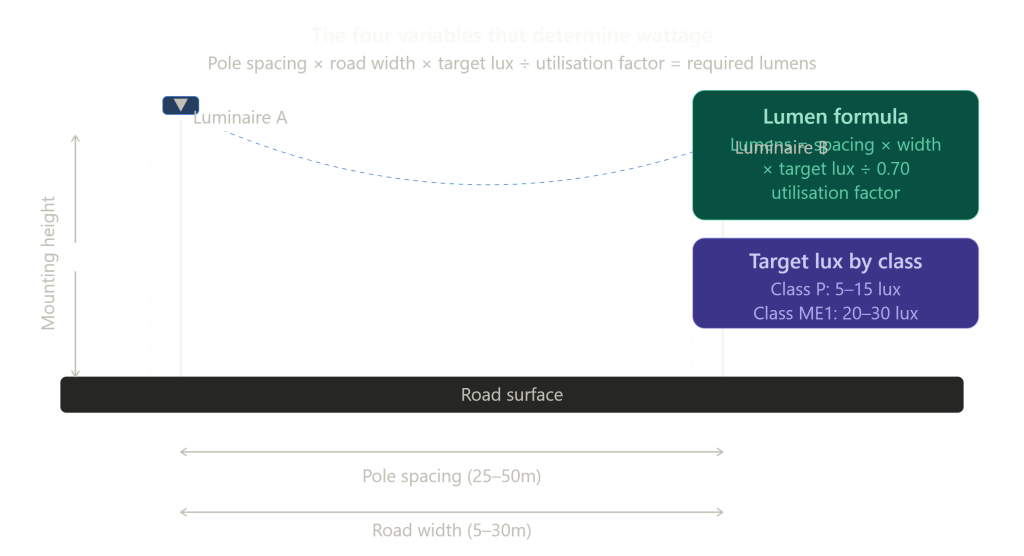
Where road area per pole = pole spacing × road width, target illuminance is set by the relevant lighting standard for your road classification, and utilisation factor (typically 0.65–0.80) accounts for the percentage of emitted lumens that actually reach the road surface.
We provide free DIALux and AGi32 photometric simulation for all Sinocoled customers — but understanding the calculation framework helps you confirm whether a supplier’s wattage recommendation is technically justified or simply commercially convenient.
Complete LED Street Light Wattage Guide by Road Classification
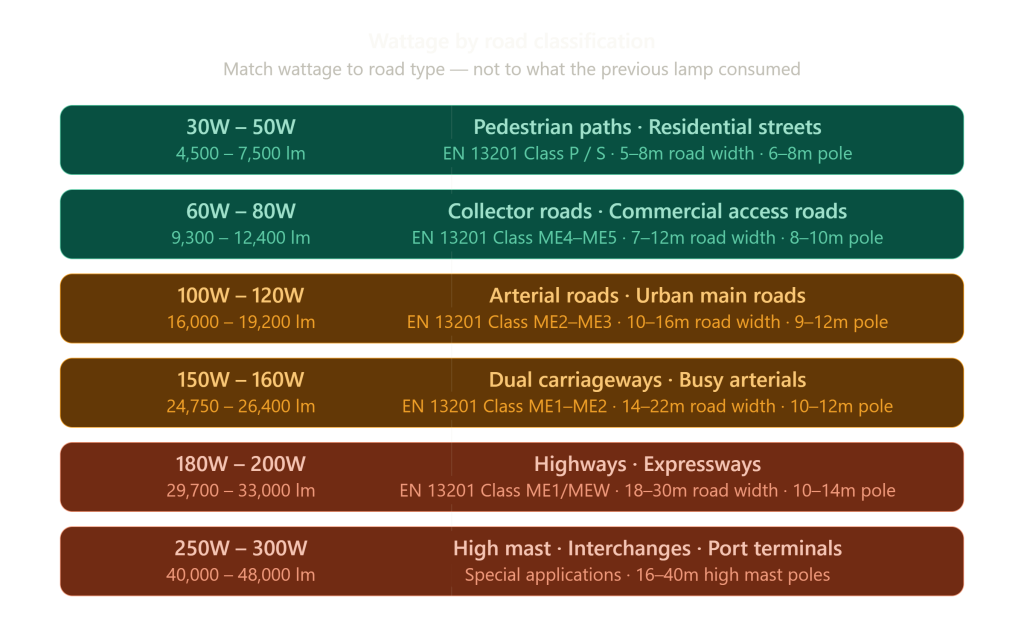
30W–50W LED Street Light — Residential Streets and Pedestrian Pathways
Applicable road classes: EN 13201 Class P (pedestrian), Class S (slow traffic), ANSI/IES RP-8 Pedestrian Way, AS/NZS 1158 P-category
Typical road characteristics:
- Road width: 5–8 metres
- Mounting height: 5–8 metres
- Pole spacing: 20–30 metres
- Traffic speed: up to 40km/h
- Target illuminance: 5–15 lux average
Who needs this wattage: Residential neighbourhood streets, shared zones, cycle paths, footpaths, park pathways, car park pedestrian areas, school zones
What 30–50W delivers at Sinocoled efficacy (150 lm/W):
- 30W = 4,500 lumens
- 40W = 6,000 lumens
- 50W = 7,500 lumens
This lumen range is more than sufficient for residential street lighting at standard pole heights and spacings — and it replaces 100–150W high-pressure sodium (HPS) lamps that delivered only 60–80 lm/W at system level after ballast losses.
Energy saving vs HPS replacement: 60–70% reduction in energy consumption
Sinocoled recommendation: Series VEGA 30W–50W with Type II or Type III optic, IP65, IK08, 4000K CCT for general residential use; 3000K CCT available for dark-sky sensitive areas
60W–80W LED Street Light — Collector Roads and Commercial Access Roads
Applicable road classes: EN 13201 Class ME4–ME5, ANSI/IES RP-8 Collector Road, AS/NZS 1158 V-category low volume
Typical road characteristics:
- Road width: 7–12 metres
- Mounting height: 8–10 metres
- Pole spacing: 25–35 metres
- Traffic speed: 40–60km/h
- Target illuminance: 15–20 lux average
Who needs this wattage: Collector roads linking residential areas to arterials, commercial estate access roads, shopping centre approach roads, light industrial estate perimeters, secondary urban roads
What 60–80W delivers at Sinocoled efficacy (155 lm/W):
- 60W = 9,300 lumens
- 80W = 12,400 lumens
Energy saving vs HPS replacement: 60–65% reduction
Sinocoled recommendation: Series VEGA 60W–80W with Type III optic for single-side pole placement, IP65, IK08, 4000K CCT. NEMA photocell socket standard for dusk-to-dawn control
100W–120W LED Street Light — Arterial Roads and Urban Main Roads
Sinocoled Series VEGA — Luminous Intensity Distribution
Polar photometric diagram — C0/180 plane (solid) · C90/270 plane (dashed) · Scale in cd per 1000 lm
Dashed line = C90 / C270 plane
Toggle products above to compare distributions
Applicable road classes: EN 13201 Class ME2–ME3, ANSI/IES RP-8 Major Road, AS/NZS 1158 V-category high volume
Typical road characteristics:
- Road width: 10–16 metres
- Mounting height: 9–12 metres
- Pole spacing: 30–40 metres
- Traffic speed: 50–80km/h
- Target illuminance: 20–30 lux average
Who needs this wattage: Urban arterial roads, dual carriageway sections, commercial high streets, industrial access roads, busy suburban intersections
What 100–120W delivers at Sinocoled efficacy (160 lm/W):
- 100W = 16,000 lumens
- 120W = 19,200 lumens
This is the wattage range where we see the most procurement errors. Many contractors specify 150W or 200W for arterial roads when photometric simulation confirms that 100W at 160 lm/W with a well-designed Type III optic achieves full compliance with EN 13201 ME2 — delivering unnecessary energy cost for the life of the installation.
Energy saving vs HPS replacement: 55–65% reduction
Sinocoled recommendation: Series VEGA 100W–120W with Type III optic, IP66, IK10, 4000K CCT. DALI or 0-10V dimming standard for adaptive control. NEMA 7-pin socket for smart city node compatibility
150W–160W LED Street Light — Dual Carriageways and Busy Urban Arterials
Applicable road classes: EN 13201 Class ME1–ME2, ANSI/IES RP-8 Major Arterial, AS/NZS 1158 V-category
Typical road characteristics:
- Road width: 14–22 metres (dual carriageway)
- Mounting height: 10–12 metres
- Pole spacing: 30–45 metres
- Traffic speed: 60–100km/h
- Target illuminance: 20–30 lux average
Who needs this wattage: Dual carriageway arterials, busy urban main roads with high pedestrian interaction, commercial strip districts, roundabouts and intersections on major urban roads
What 150–160W delivers at Sinocoled efficacy (165 lm/W):
- 150W = 24,750 lumens
- 160W = 26,400 lumens
Energy saving vs HPS replacement: 50–60% reduction (replacing 400W HPS)
Sinocoled recommendation: Series VEGA 150W with Type III or Type IV optic depending on carriageway configuration, IP66, IK10, 4000K CCT. DALI2 D4i driver standard for asset-level metering on municipal networks
180W–200W LED Street Light — Highways, Expressways, and High-Speed Roads
Applicable road classes: EN 13201 Class ME1/MEW, ANSI/IES RP-8 Freeway/Expressway, AS/NZS 1158 V1–V2 high volume
Typical road characteristics:
- Road width: 18–30+ metres (multi-lane)
- Mounting height: 10–14 metres
- Pole spacing: 35–50 metres
- Traffic speed: 80–130km/h
- Target illuminance: 20–30 lux average with high uniformity
Who needs this wattage: National and provincial highways, urban expressways, motorway on and off ramps, high-speed dual carriageways, airport access roads, port access routes
What 180–200W delivers at Sinocoled efficacy (165 lm/W):
- 180W = 29,700 lumens
- 200W = 33,000 lumens
At this wattage and mounting height, uniformity ratio — the evenness of light distribution across the carriageway — becomes as important as average illuminance. Our Type II, III, IV, and V optic options for the 180–200W range allow the lighting designer to optimise for the specific carriageway geometry rather than accepting a generic distribution.
Energy saving vs HPS replacement: 50–55% reduction (replacing 400W–600W HPS)
Sinocoled recommendation: Series VEGA 180W–200W with optic type selected per photometric simulation, IP66, IK10, 4000K CCT. DALI2 D4i and ZHAGA socket standard. 10kV surge protection minimum
250W+ LED Street Light — High-Mast, Interchange, and Special Applications
Applicable applications: Motorway interchanges, port terminals, large roundabouts, high-mast poles (20–40m), sports facility perimeter roads, large industrial site perimeters
What 250W+ delivers at Sinocoled efficacy (160 lm/W):
- 250W = 40,000 lumens
- 300W = 48,000 lumens
At these wattages, the installation is almost always on high-mast poles or serving multi-lane interchanges where light must travel significantly further to reach the road surface. The optic design becomes critical — our 250W+ range uses precision engineered deep bowl reflectors and asymmetric optics specifically calculated for high-mounting-height applications.
Sinocoled recommendation: Series VEGA 250W–300W with application-specific optic, IP67, IK10, 4000K CCT. Full smart control integration as standard
The 2026 Standards Update: What Changed and Why It Matters for Your Specification
Two significant standards changes in 2026 directly affect LED street light wattage specifications. I want to address these directly because they are already affecting tender specifications and procurement decisions.
DLC SSL V6.0 — Now in Effect
The DesignLights Consortium released SSL V6.0 in November 2025, with applications accepted from January 5, 2026. By October 1, 2026, all non-compliant products will be delisted from the DLC Qualified Products List — which affects rebate eligibility across the USA and Canada.
The key changes for street light wattage specifications are higher minimum efficacy thresholds — an average 14% increase across most product types. This means products that were DLC-listed at 130 lm/W under V5.x may no longer qualify under V6.0 without re-testing.
All Sinocoled Series VEGA products delivering 150–180 lm/W remain fully above the new DLC SSL V6.0 minimum thresholds. We hold current DLC test data and can provide V6.0 compliance documentation on request.
EN 13201:2015 and Road Lighting Class Selection
The European road lighting standard EN 13201 defines lighting classes (ME, CE, S, P) based on traffic type, speed, and road geometry. In 2026, many European municipal projects are also incorporating the CIE S 015 model for adaptive lighting — linking permitted light output reduction (dimming levels) to traffic flow data.
Our DALI2 D4i-equipped Series VEGA products are fully compatible with CIE S 015 adaptive lighting models, enabling municipalities to reduce energy consumption by a further 20–40% through intelligent dimming without any compromise to road safety standards.
Wattage vs Efficacy vs Lumen Output: The Three Numbers You Must Always Request Together
I want to give you a practical checklist for evaluating any LED street light specification — from any supplier, including us.
When a supplier quotes you a wattage, always request these three numbers before accepting the specification:
Number 1 — Luminous efficacy (lm/W): This tells you how efficiently the fixture converts electricity to light. Minimum acceptable for a 2026 specification: 130 lm/W for standard applications, 150 lm/W for premium efficiency projects. Sinocoled standard: 150–180 lm/W.
Number 2 — Total lumen output (lm): The actual light delivered by the complete luminaire system — not the LED chip alone, and not a theoretical calculation. This must come from an IES LM-79 test report from an accredited laboratory. Always request the LM-79 report, not just the datasheet figure.
Number 3 — L70 lumen maintenance rating (hours): The number of hours at which the luminaire will have depreciated to 70% of its initial lumen output — verified through LM-80 testing of the LED module and TM-21 extrapolation of the lifetime projection. Minimum acceptable: L70 ≥ 50,000 hours. Sinocoled standard: L70 ≥ 50,000 hours on all products, L80 ≥ 60,000 hours on premium Series VEGA.
Any supplier who cannot or will not provide all three numbers from independent test reports should not be on your shortlist.
Quick Reference Wattage Selection Table
| Road Type | EN 13201 Class | Road Width | Mounting Height | Recommended Wattage | Sinocoled Series |
|---|---|---|---|---|---|
| Pedestrian path / cycle lane | P / S | 3–5m | 4–6m | 20W–30W | VEGA 20–30W |
| Residential street | P / ME5 | 5–8m | 6–8m | 30W–50W | VEGA 30–50W |
| Collector / access road | ME4–ME5 | 7–12m | 8–10m | 60W–80W | VEGA 60–80W |
| Arterial / main road | ME2–ME3 | 10–16m | 9–12m | 100W–120W | VEGA 100–120W |
| Dual carriageway | ME1–ME2 | 14–22m | 10–12m | 150W–160W | VEGA 150–160W |
| Highway / expressway | ME1 / MEW | 18–30m | 10–14m | 180W–200W | VEGA 180–200W |
| Interchange / high mast | Special | 25m+ | 16–40m | 250W–300W | VEGA 250–300W |
Common Wattage Mistakes and How to Avoid Them
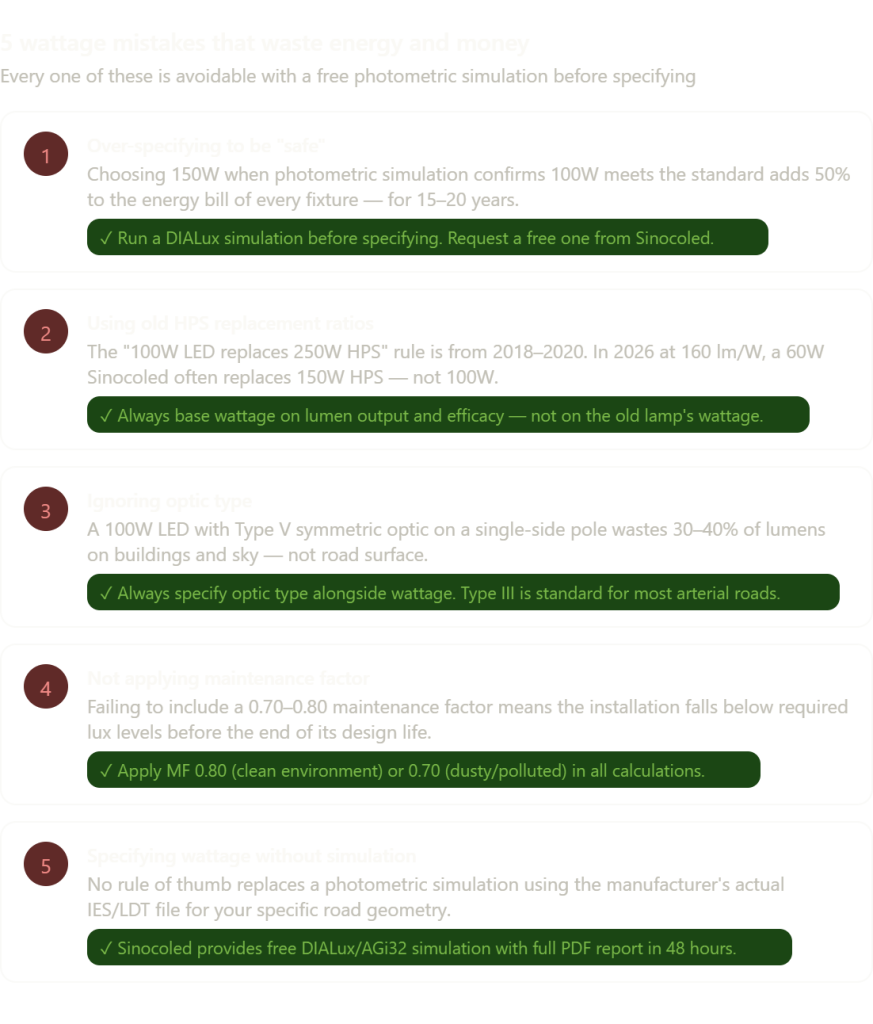
Mistake 1 — Over-specifying wattage to be “safe” This is the most common mistake we see in contractor-led specifications. Specifying 150W for a road that photometric simulation confirms needs 100W adds 50% to the energy bill of every luminaire on the project — for 15–20 years. At 1,000 luminaires running 12 hours per night, that is 219,000 kWh of wasted energy per year.
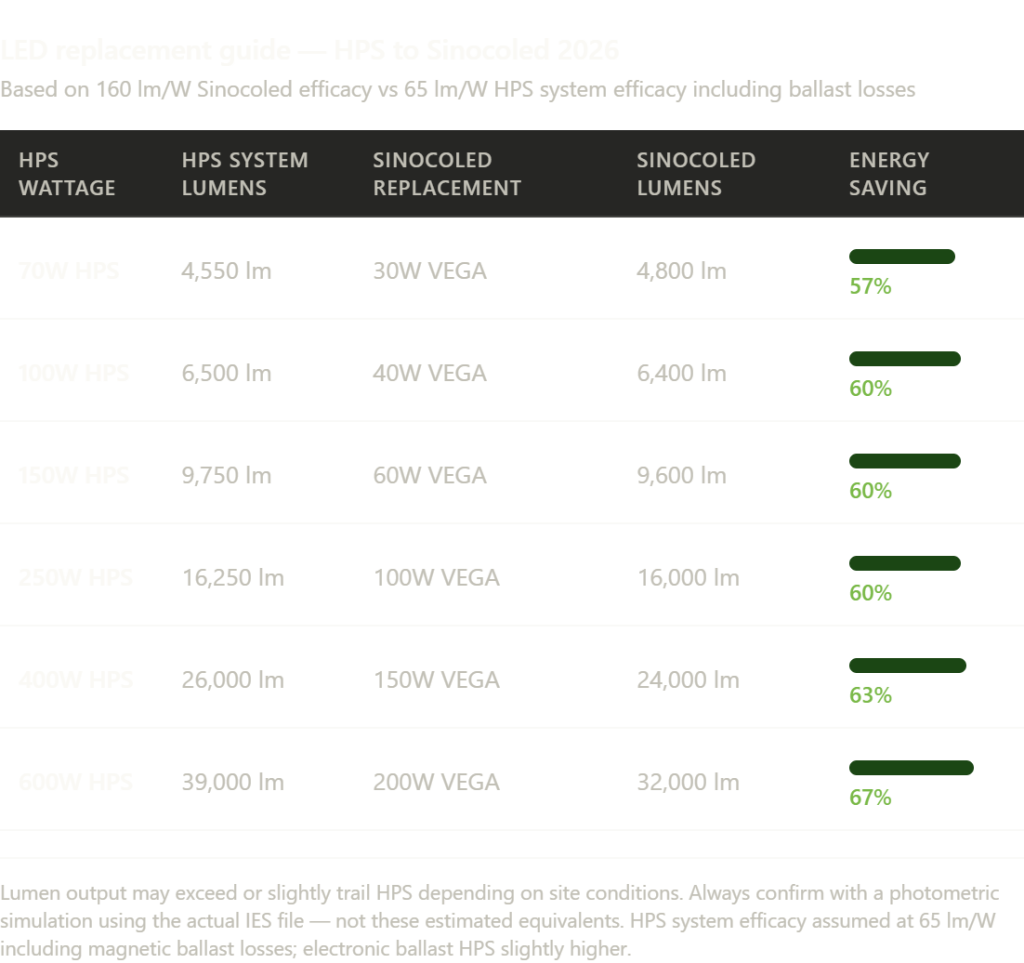
Mistake 2 — Using old HPS replacement ratios The rule of thumb that “a 100W LED replaces a 250W HPS” is based on average efficacy figures from 2018–2020. In 2026, at 160–180 lm/W, a 60W Sinocoled LED street light often replaces a 150W HPS — not a 100W. Using outdated replacement ratios leads to systematic over-specification.
Mistake 3 — Ignoring optic type A 100W LED street light with a Type V symmetric optic on a single-side-mounted pole wastes 30–40% of its lumen output illuminating buildings, gardens, and sky rather than road surface. The same 100W with a correct Type III asymmetric optic delivers full road surface coverage. Optic type is as important as wattage — always specify both.
Mistake 4 — Not accounting for maintenance factor Road lighting calculations must include a maintenance factor — typically 0.80 for LED luminaires in clean environments, 0.70 in dusty or polluted environments — that accounts for lumen depreciation over the service life. Failing to include the maintenance factor means the installation will fall below the required illuminance level before the end of its design life.
Mistake 5 — Specifying wattage without photometric simulation The only fully reliable method for confirming that a wattage selection meets the applicable lighting standard is photometric simulation using the manufacturer’s IES or LDT photometric data file in DIALux EVO or AGi32. We provide this simulation free of charge for all Sinocoled projects — contact us with your road dimensions, pole height, pole spacing, and required lighting class and we will return a full simulation report within 48 hours.
Sinocoled’s Free LED Street Light Wattage Calculation Service
We understand that not every buyer has access to DIALux or AGi32, or the time to run detailed photometric simulations for every project. That is why we offer a completely free wattage calculation and lighting design service for all Sinocoled projects — no minimum order required.
Here is what you receive:
- Recommended wattage and optic type for your specific road geometry
- Full photometric simulation with false-colour lux map
- Pole spacing and mounting height confirmation
- Compliance check against your applicable lighting standard (EN 13201, ANSI/IES RP-8, AS/NZS 1158, or any other national standard)
- PDF simulation report for submission to your client or approving authority
To use this service, simply contact us with your road width, mounting height, pole spacing, road classification, and applicable lighting standard. Our engineering team responds within 24 hours and delivers the full simulation report within 48–72 hours.
Frequently Asked Questions
What wattage LED street light do I need for a residential street? For a standard residential street with 5–8 metre road width, 6–8 metre mounting height, and 25–30 metre pole spacing, a 30W–50W LED street light delivering 4,500–7,500 lumens at 150 lm/W efficacy is typically sufficient to achieve EN 13201 Class P or ME5 compliance. Always confirm with a photometric simulation for your specific geometry.
How many lumens does a 100W LED street light produce? At Sinocoled’s standard efficacy of 150–160 lm/W, a 100W LED street light delivers 15,000–16,000 lumens. Always request the LM-79 tested lumen output figure — not a calculated or estimated figure — from any supplier before specifying.
What is the difference between 150W and 200W LED street lights? At 165 lm/W efficacy, a 150W delivers 24,750 lumens and a 200W delivers 33,000 lumens — a 33% increase in light output for a 33% increase in energy consumption. Whether 200W is justified over 150W depends entirely on your road width, mounting height, and required illuminance level. For most dual carriageway applications, 150W is sufficient. 200W becomes necessary on wider, higher-mounted applications. Photometric simulation confirms this in every case.
What wattage replaces a 250W HPS street light? At 2026 efficacy levels of 150–165 lm/W, a 60W–80W Sinocoled LED street light typically replaces a 250W HPS street light while maintaining equivalent or better road illuminance. This represents an energy saving of approximately 68–76% while also improving colour rendering (CRI 70+ vs HPS CRI 20–25) and lumen maintenance over the service life.
How do I choose between 4000K and 3000K LED street lights? 4000K (neutral white) is the standard specification for most road lighting applications in 2026, providing good visibility and colour rendering at moderate blue light content. 3000K (warm white) is recommended for dark-sky sensitive areas, residential neighbourhoods where light pollution is a concern, and locations near ecological habitats. 5000K (cool white) is sometimes specified for high-security and industrial applications but is increasingly restricted by dark-sky ordinances in many jurisdictions.
Does wattage affect the IP rating of an LED street light? No — IP rating is determined by the housing design and sealing, not the wattage. However, higher-wattage luminaires generate more heat and must be designed with more robust thermal management — which is why our 150W+ Series VEGA range uses a larger die-cast aluminium housing with extended heat dissipation fins compared to the 30W–80W range.
Can I mix different wattages on the same road? Yes — in fact, this is sometimes the correct approach. Intersections and roundabouts often require higher wattage luminaires than the straight road sections between them, since the wider area and more complex traffic geometry require higher illuminance. Mixing 100W straight-section luminaires with 150W or 200W intersection luminaires on the same project is a legitimate and increasingly common specification approach.
Does Sinocoled offer adjustable wattage street lights? Yes. Our Series VEGA range includes selectable wattage options — for example, a 100W/80W/60W selectable configuration allows the installer to set the operating wattage at commissioning, or to change it remotely via DALI2 control. This provides inventory flexibility for distributors and design flexibility for engineers who want to future-proof the installation.
Why Sinocoled for Your LED Street Light Project
We have been manufacturing LED street lights for over 20 years. Our Series VEGA range covers every wattage from 20W to 300W, every optic type from Type II to Type V, and every control interface from basic photocell to DALI2 D4i smart city integration.
Every product in our range is independently tested to LM-79 and LM-80. We hold CE, ENEC, CB, and RoHS certification. We offer free photometric simulation for every project. We operate with no minimum order quantity — you can order one sample this week or a 10,000-unit container next month, and you receive the same quality, the same documentation, and the same technical support.
If you are specifying an LED street lighting project and want confirmation that you are choosing the right wattage before you commit — contact our engineering team. The simulation is free. The advice is honest. And the products are built to last 20 years in the field.
Ready to specify your project? Visit sinocoled.com to request a free photometric simulation, download IES photometric files, or speak directly with our street lighting engineering team.