

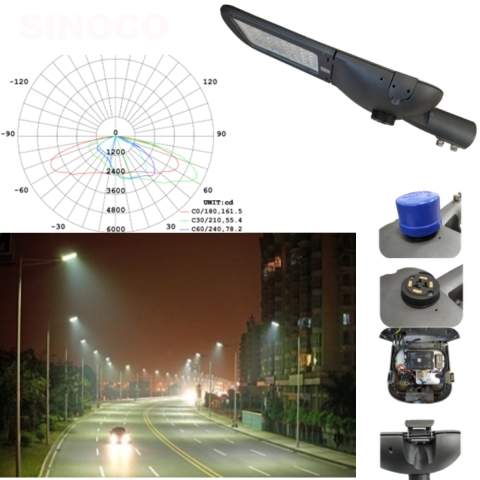
Every LED street light project starts with the same question: what wattage do I need? The honest answer is that it depends on four variables — road width, mounting height, pole spacing, and target lux level. Get those four numbers right, run the calculation, and the wattage follows. Get them wrong, and you either over-spend on energy for 20 years or install a road that fails its lighting standard before the ink dries on the commissioning report.
I have reviewed hundreds of street light specifications across 40+ countries over 20 years of LED manufacturing. The most expensive mistakes are never caused by choosing the wrong brand. They are caused by skipping the calculation entirely and guessing the wattage based on what the old lamp said on the box.
LED Street Light Wattage Calculator: How to Get the Right Wattage Every Time in 2026
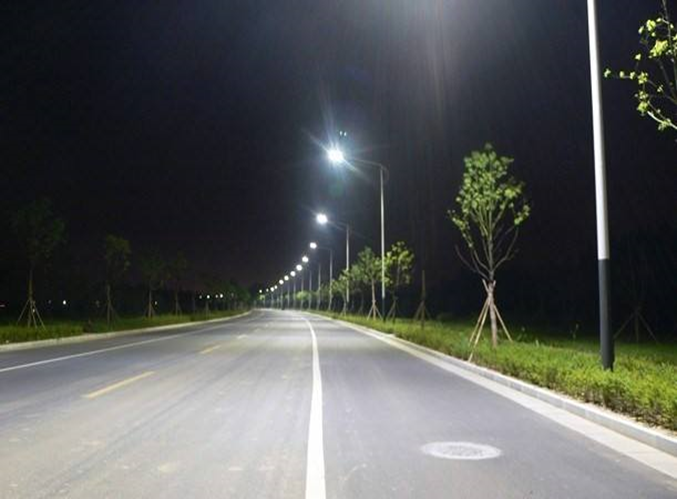
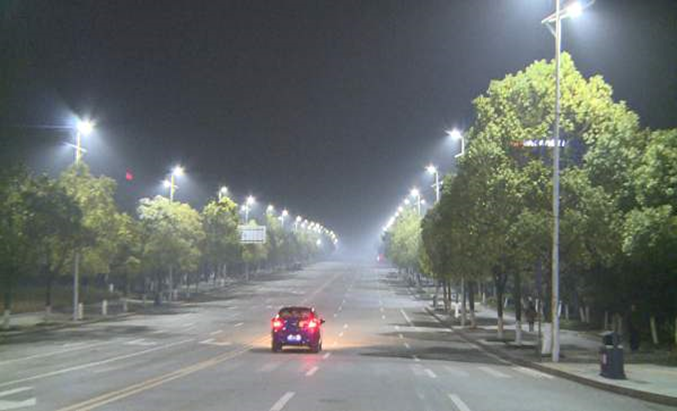
This guide gives you the formula, the EN 13201 lux standards, a free interactive wattage calculator, and the complete context to understand what the result means — so you can specify with confidence and never over-specify again.
Use Our Free LED Street Light Wattage Calculator
Enter your road geometry and required lighting class below. The calculator applies the EN 13201 lumen formula with a standard maintenance factor and returns the recommended wattage and Sinocoled Series VEGA product for your application.
The Formula Behind the Calculator — Explained Simply
The wattage calculation for LED street lights follows a straightforward sequence. Understanding each step means you can check any supplier’s specification claim — and spot over-specification immediately.
Step 1 — Calculate road area per pole
The road area that each pole is responsible for illuminating is determined by pole spacing and road width. For a single-side arrangement, this is the full road width. For staggered poles, each pole serves half the road width from each side.
Road area per pole (m²) = Pole spacing (m) × Road width (m)
Example: 35m spacing × 10m road width = 350 m²
Step 2 — Apply target illuminance (lux)
Target illuminance is set by the EN 13201 lighting class for the road type. It represents the maintained average illuminance level that must be achieved at the road surface — not the initial level when the luminaire is new, but the sustained level over the operational life of the installation after accounting for lumen depreciation and dirt accumulation.
Raw lumens needed = Road area (m²) × Target lux (lx)
Example: 350 m² × 20 lux (Class ME3) = 7,000 raw lumens
Step 3 — Apply maintenance factor and utilisation factor
Two correction factors adjust the raw lumen figure upward to account for real-world losses. The maintenance factor (MF) compensates for lumen depreciation and dirt accumulation over time. The utilisation factor (UF) accounts for the percentage of emitted lumens that actually reach the road surface rather than being lost to sky, buildings, and surroundings.
Required lumens = Raw lumens ÷ MF ÷ UF
Example: 7,000 ÷ 0.80 (MF) ÷ 0.72 (UF) = 12,153 lumens required
Step 4 — Convert lumens to wattage
Once you know the required lumen output, divide by the luminaire efficacy in lumens per watt. At Sinocoled’s standard efficacy of 160 lm/W for our Series VEGA range, the calculation gives you the minimum wattage required — then round up to the nearest available product configuration.
Minimum wattage = Required lumens ÷ Efficacy (lm/W)
Example: 12,153 ÷ 160 lm/W = 76W → round up to 80W VEGA
The single most important number in this formula is efficacy (lm/W). A supplier offering 100 lm/W requires 60% more wattage than a 160 lm/W Sinocoled product to achieve the same lux level. Always request the LM-79 tested efficacy figure — not the datasheet estimate — before comparing wattages across suppliers.
EN 13201 Lux Standards: Target Illuminance by Road Class
The target illuminance value in the calculator is set by the EN 13201 lighting class. Here are the classes most commonly specified in road lighting projects worldwide in 2026, with the maintained average illuminance requirements and the road types they apply to.
| EN 13201 class | Target lux (Em) | Road type | Typical wattage range |
|---|---|---|---|
| Class P (P1–P6) | 5 – 15 lux | Pedestrian paths, cycle lanes, residential zones | 20W – 50W |
| Class ME5 | 10 lux | Residential streets, low-traffic collectors | 30W – 60W |
| Class ME4 | 15 lux | Collector roads, commercial access roads | 60W – 80W |
| Class ME3 | 20 lux | Arterial roads, urban main roads | 80W – 120W |
| Class ME2 | 25 lux | Dual carriageways, busy arterials | 120W – 160W |
| Class ME1 | 30 lux | Highways, expressways, motorways | 150W – 200W |
| Class C (C0–C5) | 30 – 50 lux | Conflict zones, intersections, roundabouts | 150W – 250W |
The 2026 update to the DLC SSL V6.0 standard — effective January 2026 — has also raised minimum efficacy thresholds by an average of 14% for products seeking DLC qualification in North American markets. Sinocoled Series VEGA products at 160 lm/W exceed the new thresholds across all wattage configurations.
Five Common Wattage Calculation Mistakes — and How to Avoid Each One
1. Using the old HPS wattage as the LED starting point
A 250W HPS lamp does not need a 250W LED replacement. At 65 lm/W system efficacy (including ballast losses), 250W HPS delivers about 16,000 system lumens. A 100W Sinocoled VEGA at 160 lm/W delivers the same 16,000 lumens — at 60% lower energy consumption. Starting from the old lamp wattage leads to systematic over-specification.
Fix: always start from lux level and road geometry — never from the old lamp wattage.
2. Forgetting the maintenance factor
Specifying a luminaire that delivers exactly the required lux when new means it will fall below the required level within 2–3 years as lumen output depreciates and dirt accumulates. The maintenance factor (0.70–0.80) must be applied to the calculation so the installation meets its lighting class requirement throughout its design life, not just on commissioning day.
Fix: always divide required lumens by MF (0.80 clean / 0.75 moderate / 0.70 polluted).
3. Ignoring pole arrangement when calculating road area
Staggered poles on both sides of a road mean each pole is responsible for half the road width from its side — not the full road width. Using full road width for a staggered arrangement overstates the required lumen output by up to 50%, producing a significant over-specification in wattage.
Fix: adjust road area per pole based on arrangement — single side uses full width, staggered uses effective half-width per pole.
4. Treating the wattage calculator result as final
A lumen formula calculator gives a reliable starting point — it does not replace photometric simulation. Uniformity ratio, glare threshold (TI), and longitudinal uniformity requirements from EN 13201-2 can only be verified through a full photometric simulation using the actual IES or LDT file of the proposed luminaire.
Fix: use the calculator for initial wattage selection, then confirm with a Sinocoled DIALux simulation before committing to specification.
5. Specifying wattage without specifying efficacy
Two suppliers quoting “100W LED street light” may be offering products with 100 lm/W and 160 lm/W efficacy respectively — a 60% difference in light output at the same wattage. Without specifying minimum efficacy (lm/W) alongside wattage, the specification is incomplete and open to substitution with inferior products that pass the wattage criterion while failing the lighting standard on site.
Fix: always specify minimum efficacy (≥150 lm/W for 2026 projects) alongside wattage in every project specification.
How Mounting Height and Pole Spacing Affect Wattage
Two variables in the calculator deserve extra explanation because they interact with each other in ways that are not always intuitive — and getting them wrong in either direction increases project cost.
Mounting height
Higher mounting height means the same luminaire must illuminate a larger ground area from further away. This reduces the lux level reaching the surface, requiring more lumens — and therefore more wattage — to compensate. However, higher mounting also improves uniformity by reducing the dark patches between poles. The optimum mounting height for most arterial roads is 10–12 metres, where the relationship between coverage area and uniformity ratio is best balanced.
As a practical rule, we recommend mounting height of approximately 1.0–1.2 times the road width for single-side mounting, and 0.5–0.6 times the road width for opposite-side or staggered mounting. For a 10-metre road, that means a 10–12 metre pole — not the 8-metre pole that costs less to install but requires 30–40% more wattage to achieve the same lux level.
Pole spacing
Pole spacing directly determines the road area each luminaire must cover. Doubling pole spacing from 25 metres to 50 metres doubles the road area per pole — and doubles the required lumen output per luminaire. Wider spacing saves installation cost (fewer poles, less cabling) but requires higher wattage luminaires that may cost more per unit and consume more energy per pole.
The economic optimum for most projects lies in the 30–40 metre pole spacing range for arterial roads at 10 metre mounting height. Below 25 metres, the savings in wattage do not offset the additional pole and cabling cost. Above 45 metres, the required lumen output per luminaire often pushes beyond 200W, which increases unit cost significantly.
Sinocoled Series VEGA Wattage Range — Quick Reference
Every wattage in our Series VEGA range is available in standard stock configurations with full EN 13201 photometric data, CE certification, and LM-79 test reports. Here is the complete quick reference for specifiers.
| Model | Wattage | Lumens | Efficacy | Best application | IP/IK |
|---|---|---|---|---|---|
| VEGA-30 | 30W | 4,800 lm | 160 lm/W | Residential, pedestrian paths | IP65 / IK08 |
| VEGA-50 | 50W | 8,000 lm | 160 lm/W | Residential streets, Class ME5 | IP65 / IK08 |
| VEGA-80 | 80W | 12,800 lm | 160 lm/W | Collector roads, Class ME4 | IP65 / IK09 |
| VEGA-100 | 100W | 16,000 lm | 160 lm/W | Arterial roads, Class ME3 | IP66 / IK10 |
| VEGA-120 | 120W | 19,200 lm | 160 lm/W | Main roads, Class ME2–ME3 | IP66 / IK10 |
| VEGA-150 | 150W | 24,000 lm | 160 lm/W | Dual carriageways, Class ME2 | IP66 / IK10 |
| VEGA-200 | 200W | 32,000 lm | 160 lm/W | Highways, Class ME1 | IP66 / IK10 |
| VEGA-250 | 250W | 40,000 lm | 160 lm/W | High mast, interchanges | IP67 / IK10 |
All Series VEGA models support DALI2 D4i dimming, 0-10V dimming, NEMA 7-pin socket, and ZHAGA Book 18 socket as standard. Optic types II, III, IV, and V are available on all models. CE, RoHS, and CB certification included. LM-79 and LM-80 test reports available on request.
Frequently Asked Questions
How do I calculate the right wattage for an LED street light?
The correct formula is: Required lumens = (Road width × Pole spacing × Target lux) ÷ Maintenance factor ÷ Utilisation factor. Then divide required lumens by your luminaire efficacy (lm/W) to get the minimum wattage. Use our free calculator above to get an instant result for your specific road geometry and EN 13201 lighting class.
What lux level do I need for a main arterial road?
Under EN 13201, arterial and main roads typically fall under Class ME2 or ME3, requiring a maintained average illuminance of 20–25 lux. For highways and expressways (Class ME1), the target rises to 30 lux. For residential streets (Class ME5), 10 lux is the standard target. Always confirm the applicable class with your local highway authority or municipal engineer before specifying.
What is the maintenance factor and why does it matter?
The maintenance factor (MF) accounts for the reduction in light output that occurs over time due to LED lumen depreciation, dirt accumulation on the lens, and environmental degradation. A typical MF for LED street lights in a clean urban environment is 0.80 — meaning the luminaire must be specified to deliver 25% more lumens than the target lux level requires at installation, so it still meets the target after years of depreciation. In polluted or coastal environments, use MF 0.70–0.75.
What is the utilisation factor in street light calculations?
The utilisation factor (UF) is the proportion of the total lumens emitted by the luminaire that actually reaches the road surface. A Type III asymmetric optic on a well-positioned pole typically achieves a UF of 0.70–0.75 — meaning 70–75% of emitted lumens hit the road. The remaining 25–30% illuminates footpaths, verges, and buildings. UF is determined by optic type, pole position relative to the carriageway, and mounting height. It must be obtained from the manufacturer’s photometric data, not assumed.
What wattage LED replaces a 250W HPS street light?
A 100W Sinocoled Series VEGA typically replaces a 250W HPS street light. At 160 lm/W, the VEGA-100 delivers 16,000 lumens — comparable to a 250W HPS system delivering approximately 16,250 system lumens at 65 lm/W (including magnetic ballast losses). This represents a 60% reduction in energy consumption. For electronic ballast HPS systems with slightly higher system efficacy, a 100W or 120W LED may be appropriate — always confirm with a photometric simulation.
Is the wattage calculator result accurate enough to use for a project specification?
The calculator gives a reliable first-pass wattage estimate based on the EN 13201 illuminance formula with standard maintenance and utilisation factors. It is accurate enough to confirm product selection and prepare a budget estimate. For final project specification — particularly for municipal tender documents — it should be followed by a full photometric simulation using the luminaire’s actual IES or LDT photometric file in DIALux EVO or AGi32.
Does pole spacing affect which wattage I need?
Yes — directly and significantly. Pole spacing determines the road area each luminaire is responsible for illuminating. Doubling pole spacing from 25m to 50m doubles the road area per pole and roughly doubles the required lumen output. A project that uses 80W luminaires at 25m spacing would need approximately 160W luminaires at 50m spacing to achieve the same lux level. Always calculate wattage for your specific pole spacing rather than using a generic recommendation.
Sinocoled is a professional LED street light manufacturer based in China, exporting to 40+ countries. All Series VEGA products are CE certified, LM-79 tested, and supported by a direct engineering team. Calculator results are estimates based on EN 13201 illuminance formula with standard MF and UF values. Always confirm final specification with photometric simulation using actual IES/LDT data.